

Drum Fertilizer Cooler
This cooler used for the production of compound fertilizer, cool fertilizer with certain temperature and particle size. Use dryer together can greatly improve the cooling rate, reduce labor intensity and improve the quality, further remove moisture
DETAILS
The drum fertilizer cooler is a heat-exchange device designed to rapidly lower the temperature of high-temperature fertilizer granules—fresh from the drying process—to a level suitable for packaging. Typically installed downstream of the rotary dryer and upstream of the screening and packaging units, it serves as a critical piece of auxiliary equipment in production lines for organic, compound, and blended fertilizers.
In simple terms, fertilizer granules exiting the dryer usually range in temperature from 80°C to 120°C. If packaged without adequate cooling, they continue to dissipate heat and clump together inside the bags; residual heat can even lead to mold growth or granule breakage. The function of the rotary cooler is to quickly bring these hot granules down to near-ambient temperatures (typically ≤40°C) while simultaneously removing additional moisture and enhancing granule strength.
What is the working principle of the drum fertilizer cooler?
The working principle of the drum fertilizer cooler is straightforward, yet its design prioritizes efficiency.
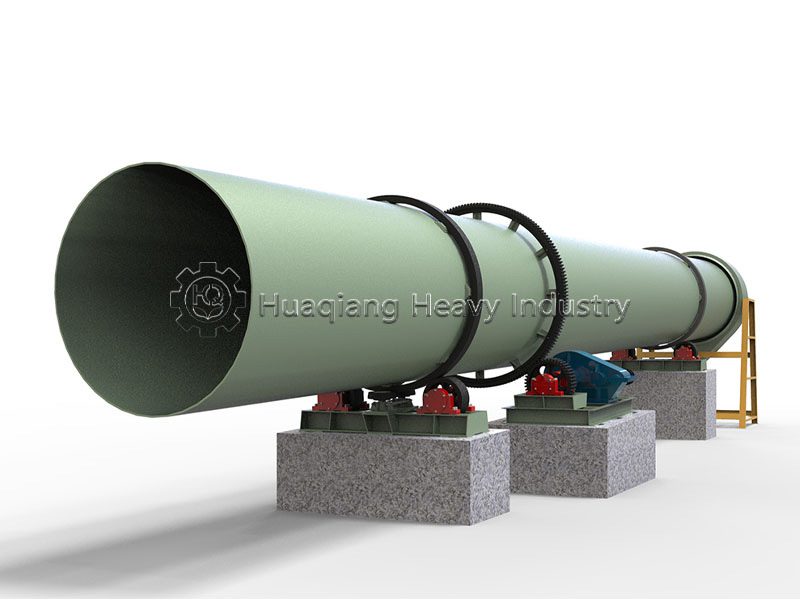
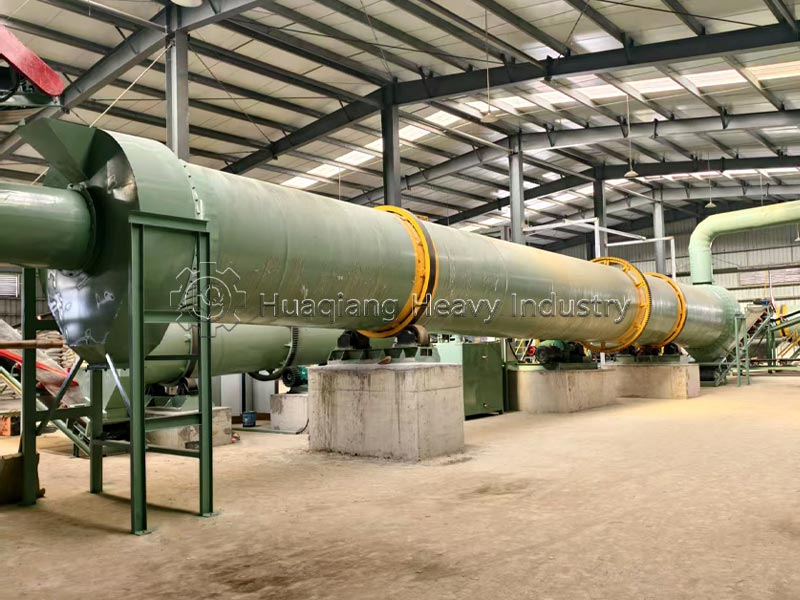
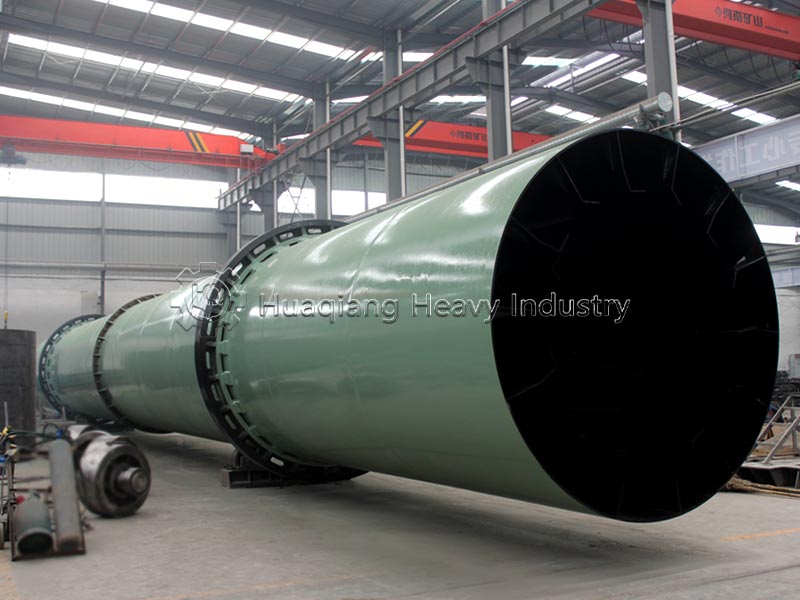
The main body of the equipment consists of an inclined rotary drum. During operation, the main motor drives a speed reducer via a belt and pulley system; the reducer then drives the drum’s rotation by meshing a split gear on the drive shaft with a large ring gear mounted on the drum itself. High-temperature material enters the drum at the feed end and gradually moves toward the discharge end as the drum rotates.
The cooling process relies on two core mechanisms:
First, counter-current air cooling.
Cool air enters from the discharge end and flows in the opposite direction to the hot material entering from the feed end. This counter-current design ensures the cool air first contacts the material that has already cooled the most (near the discharge point) before progressing toward the hotter zones, resulting in higher heat exchange efficiency. An induced draft fan continuously extracts air from the outlet at the head of the machine, accelerating airflow within the drum.
Second, the action of lifting flights.
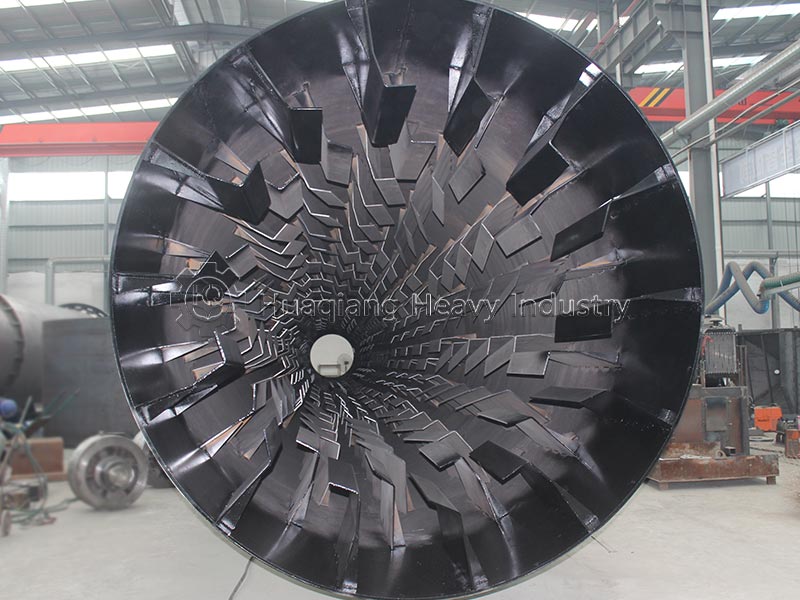
Lifting flights (also known as material lifters or scoops) are installed on the inner wall of the drum. As the drum rotates, these flights continuously lift and drop the material, creating a uniform curtain of material. This ensures that every fertilizer granule comes into full contact with the cool air, eliminating any “dead zones” where cooling might be ineffective.
Through this process, the material temperature drops below 40°C; the material is then discharged from the outlet and proceeds to the next stage of production.
What are the application scenarios and advantages of drum fertilizer coolers?
Drum fertilizer coolers are primarily used in the following scenarios:
Cooling granulated products after the drying stage in organic, bio-organic, and compound fertilizer production lines
Resource recovery projects utilizing livestock and poultry manure (chicken, cattle, and pig manure)
Fertilizer production projects using agricultural waste such as crop stalks and spent mushroom substrate
Post-processing stages to prevent caking and mold growth in granular fertilizers
Compared to other cooling methods, drum fertilizer coolers offer several distinct advantages:
High processing capacity and broad adaptability. These coolers can handle granular materials with varying particle sizes and moisture content, demonstrating good tolerance for fluctuations in input material. Suitable models are available for everything from large-scale compound fertilizer lines to small- and medium-sized organic fertilizer projects.
Uniform cooling and minimal particle breakage. The combination of a counter-current airflow and the lifting action of internal flights ensures even cooling without temperature “dead zones.” Materials tumble freely within the drum, avoiding the particle breakage often caused by forced-agitation equipment.
Stable operation and manageable maintenance costs. The equipment features a relatively simple structure and uses highly standardized wear parts. The use of a thickened drum shell and wear-resistant components extends the machine’s service life to 8–10 years.
Compatibility with automated control systems. Modern drum fertilizer coolers are typically equipped with PLC control systems and variable frequency drives (VFDs). This allows for real-time adjustment of drum rotation speed and airflow based on material characteristics and production requirements, enabling seamless automation across the entire production line.
The drum fertilizer cooler is not a complex piece of machinery, yet it plays an irreplaceable role in the fertilizer production line. Bridging the temperature gap—often tens of degrees—between hot granules and ready-to-package finished products relies entirely on this continuously rotating drum and its precisely engineered internal lifting flights. With the right model, proper operation, and diligent maintenance, it can serve the production line faithfully for seven or eight years, quietly and safely delivering every single fertilizer granule into the packaging bag.
PARAMETERS
| Model | shell | Feed temperature | Discharge temperature | Motor | Decele vators model | |||||
| Inner diam | Length | Inclination | Rotation speed | Model | Power | Rotation speed | ||||
| mm | mm | (0) | r/min | °C | °C | kW | r/min | |||
| LQ10100 | 1000 | 10000 | 2-5 | 4.6 | 60-80 | <40 | Y132m-4 | 7.5 | 1440 | ZQ350 |
| LQ12120 | 1200 | 12000 | 2-5 | 4.6 | 60-80 | <40 | Y132m-4 | 7.5 | 1440 | ZQ350 |
| LQ15120 | 1500 | 12000 | 2-5 | 5 | 60-80 | <40 | Y160L-4 | 15 | 1440 | ZQ400 |
| LQ15150 | 1500 | 15000 | 2-5 | 5 | 60-80 | <40 | Y160L-4 | 15 | 1440 | ZQ500 |
| LQ18160 | 1800 | 16000 | 2-5 | 5 | 60-80 | <40 | Y200 L1-6 | 18.5 | 970 | ZQ500 |
| LQ20200 | 2000 | 20000 | 2-5 | 5 | 60-80 | <40 | Y200 L1-6 | 22 | 970 | ZQ650 |