

Drum Fertilizer Dryer
Rotary drum dryer is mainly used to produce compound fertilizer and dry a certain temperature and granularity of fertilizer. On the other hand, it also can be used for drying other materials.


DETAILS
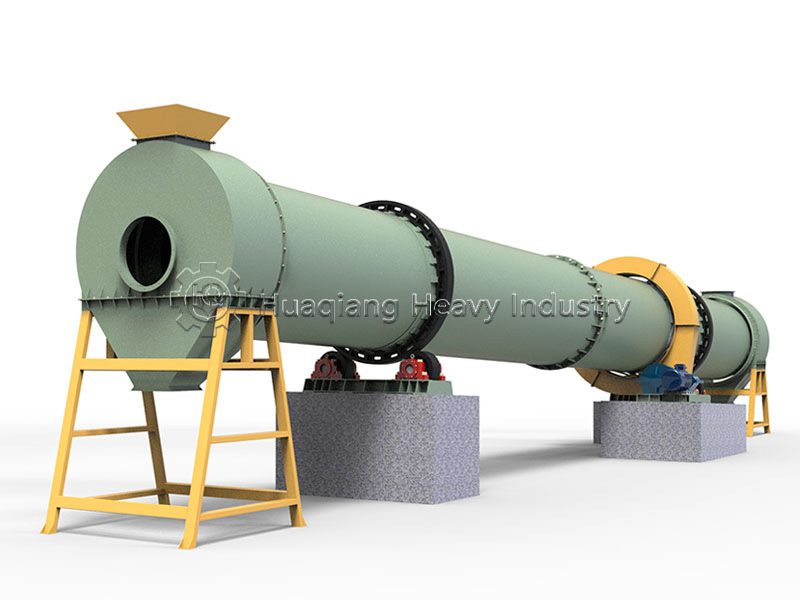
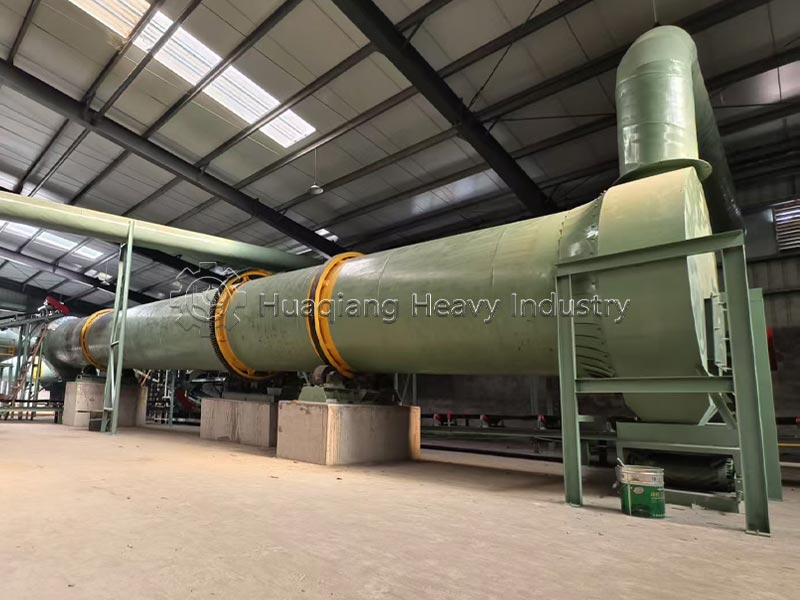
The drum fertilizer dryer is a type of continuous rotary drying equipment, featuring a main body consisting of a rotating cylinder slightly inclined relative to the horizontal. Thanks to its continuous operation capabilities and broad material adaptability, it has become one of the most common pieces of core equipment in production lines for organic fertilizers, bio-organic fertilizers, and compound fertilizers.
How does the drying process take place inside a drum fertilizer dryer?
To understand the operating principle of a drum fertilizer dryer, it helps to start from the moment the material enters the drum.
Wet material is fed into the rotating drum by a feeding mechanism, where lifting flights (or baffles) evenly distributed along the inner wall continuously scoop up and scatter the material. Throughout this process, the material is repeatedly lifted to the upper part of the drum and allowed to fall, creating a uniform “curtain of material” that makes full contact with the high-temperature hot air introduced from one end. The hot air can flow in the same direction as the material (co-current flow) or in the opposite direction (counter-current flow), depending on the material’s characteristics and specific process requirements. As the hot air comes into direct contact with the material, moisture evaporates and is carried out of the drum with the exhaust gas. The dried material is discharged through the outlet at the lower end of the drum and proceeds to the next stage, such as cooling or screening.
In short, the drum fertilizer dryer employs a combination of tumbling action and hot air to ensure that every fertilizer granule is heated evenly, thereby avoiding the “dry outside, wet inside” issue often associated with static drying methods.
Core Structural Components of the Drum Fertilizer Dryer
The drum fertilizer dryer is a type of rotary drying equipment, and the unit as a whole consists of several core components. The drum is the largest component; it is a rotating cylinder positioned at a slight incline relative to the horizontal. The front and rear ends of the drum serve as the feed and discharge ends, respectively: the feed end connects to the feed chute and the hot air duct, while the discharge end connects to the discharge assembly and the dust removal system.
Scope of Application and Industry Uses of Drum Fertilizer Dryers
Drum fertilizer dryers have a wide range of applications in the fertilizer industry. In terms of material form, they can process granular, lump, and powdered materials, and are particularly well-suited for handling materials with high moisture content and moderate stickiness.
Organic Fertilizer Production
They are commonly used to dry fermented livestock and poultry manures, such as pig, chicken, and cattle manure. The dried product can be sold as organic fertilizer, used as a growth medium for edible fungi, or utilized as animal feed.
Compound Fertilizer Production
Rotary drum dryers are standard equipment for the drying stage following granulation. A complete bio-organic fertilizer production line typically includes a mixer, granulator, rotary drum dryer, rotary drum cooler, grading screen, and metering packaging machine.
Mineral Products and Chemicals
Beyond the fertilizer industry, these dryers are also widely used for drying mineral products (such as fluorite powder, quartz sand, and graphite) and chemical products (such as ammonium sulfate, urea, and compound fertilizers).
Why is the drum fertilizer dryer essential for fertilizer production?
Freshly granulated fertilizer typically has a moisture content ranging from 10% to 30% or even higher. If packaged and stored directly, the product is highly susceptible to heating, caking, and crumbling during storage or transport due to microbial activity. Drum fertilizer dryers employ forced dehydration to reduce the final moisture content to 2%–5% or lower, creating a hardened outer shell on the granules that significantly enhances compressive strength; simultaneously, this process eliminates the “liquid bridges” and “salt bridges” between granules, thereby preventing caking at the source.
PARAMETERS
| Model | Shell | Capacity | Inlet temp of hot air | Outlet temp ofhot air | Motor | Decelevators model | |||||
| Inner diam | Length | Inclination | Rotation speed | Model | Power | Rotation Speed | |||||
| mm | mm | 0 | r/min | t/h | °C | °C | kW | r/min | |||
| ZG12120 | 1200 | 12000 | 2-5 | 4.7 | 2-2.5 | 150-250 | 60-80 | Y160M-4 | 7.5 | 1460 | ZQ350 |
| ZG15120 | 1500 | 12000 | 2-5 | 5.0 | 4-6 | 150-250 | 60-80 | Y160L-4 | 15 | 1440 | ZQ400 |
| ZG15150 | 1500 | 15000 | 2-5 | 5.0 | 5-7 | 150-250 | 60-80 | Y160L-4 | 15 | 1440 | ZQ500 |
| ZG18150 | 1800 | 15000 | 2-5 | 3.9 | 7-10 | 150-250 | 60-80 | Y200L1-6 | 18.5 | 970 | ZQ500 |
| ZG20200 | 2000 | 20000 | 2-5 | 3.9 | 8-14 | 150-250 | 60-80 | Y200L2-6 | 22 | 970 | ZQ650 |
| ZG22220 | 2200 | 22000 | 2-5 | 3.2 | 12-16 | 150-250 | 60-80 | Y250M-6 | 37 | 980 | ZQ750 |
| ZG24240 | 2200 | 24000 | 2-5 | 3.0 | 14-19 | 150-250 | 60-80 | Y280S-6 | 45 | 970 | ZQ850 |