

In the field of organic waste resource utilization and environmental governance, the trough-type compost turner, with its high efficiency, intelligence, and environmental friendliness, has become a core piece of equipment in industries such as organic fertilizer production and sludge treatment, quietly driving the development of the green circular industry. With its scientific design concept, it solves the pain points of low efficiency and uneven fermentation in traditional composting methods, providing solid support for large-scale and standardized production.
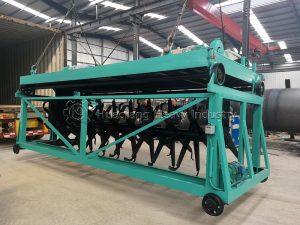
The trough-type compost turner is mainly used for the aerobic fermentation treatment of organic waste such as livestock and poultry manure, urban sludge, and straw sawdust. Relying on its track-mounted movement and adjustable turning teeth design, it achieves full-depth and full-width turning of materials in the fermentation tank. Its turning depth can reach 1.2-2.5 meters, and the width can be customized according to needs. A single movement can complete the turning of the entire tank of materials, leaving no dead corners or residues, ensuring that every piece of material fully contacts oxygen, creating optimal conditions for microbial composting.
Compared to traditional methods such as manual turning and loader turning, the advantages of the trough-type compost turner are particularly prominent. It achieves automated operation, allowing for PLC programming to preset turning times and speeds. One unit can manage multiple fermentation tanks, significantly reducing labor costs. Deep turning shortens the fermentation cycle from 25-30 days to 15-20 days, while also stabilizing material temperature, thoroughly killing insect eggs and pathogens, and improving organic fertilizer quality.
Environmental friendliness is another major highlight of the trough compost turner. It can be used with a gas collection hood to direct odorous gases generated during fermentation into deodorization equipment, preventing fugitive emissions. Simultaneously, turning regulates material moisture, reducing leachate production and meeting environmental compliance requirements. Furthermore, the energy-saving variable frequency model can automatically adjust power based on material resistance, reducing energy consumption by 20%-40% compared to traditional equipment, balancing cost reduction and low carbon footprint.
Today, trough type compost turners are widely used in organic fertilizer plants, sludge treatment plants, and horticultural farms, solving organic waste pollution problems and achieving resource recycling. Empowering green development with technology, and contributing to sustainable agricultural development with high efficiency and environmental protection, it serves as a crucial bridge connecting organic waste and green fertilizer, demonstrating the significant value of technology in serving the ecosystem.