

As a core piece of equipment in the production of organic fertilizer and compound fertilizer, the standardized operation of a disc granulator directly determines the granule quality, production efficiency, and equipment lifespan. Mastering key production points can effectively improve pelleting rate, reduce losses, and achieve stable and efficient production. The following is a detailed analysis of the core processes.
Raw material pretreatment is the foundation of production and directly affects the granulation effect. The moisture content of the raw materials must be controlled between 18% and 25%. Too high a moisture content can easily lead to granule sticking and clumping, while too low a moisture content makes pelleting difficult. At the same time, the raw materials must be crushed and screened to remove stones and impurities, ensuring uniform particle size and avoiding wear on the equipment or affecting granule formation. For organic fertilizer raw materials such as livestock and poultry manure and straw, it is recommended to ferment and decompose them in advance to reduce odor and clumping during the granulation process.
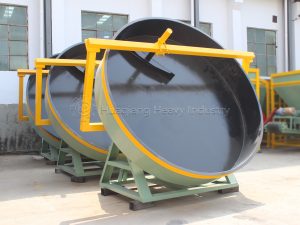
Equipment debugging and parameter control are crucial. Before starting the machine, check the disc tilt angle and rotation speed. Generally, the tilt angle should be adjusted to 45°-55°. The rotation speed should be adjusted flexibly according to the raw material characteristics and particle size. Too high a speed can lead to overly fine particles and low pelleting rate, while too low a speed will cause particles to stick together and reduce output. At the same time, check the scraper position to ensure it fits tightly against the inner wall of the disc, and promptly scrape off any material adhering to the wall to avoid affecting granulation uniformity.
The operating procedures during granulation are crucial. Feeding must be uniform and continuous to avoid overloading the disc, which can affect equipment operation and particle quality. When adding binder, control the amount and spray evenly. Too much binder can cause particles to be too hard and difficult to dissolve, while too little can result in loose and easily broken particles. During production, observe the particle state in real time and adjust parameters such as moisture content and rotation speed promptly to ensure round and uniform particle size.
Daily equipment maintenance is a prerequisite for continuous production. After production, promptly clean the inner wall of the disc, the scraper, and the feed inlet of any residual material to prevent material agglomeration and corrosion of the equipment. Regularly inspect easily worn parts such as bearings and gears, add lubricating oil, and replace worn parts promptly to prevent equipment failures from affecting production progress.
In summary, the production of disc granulators requires a comprehensive approach, considering raw material pretreatment, equipment debugging, process operation, and daily maintenance. Strict control over each key aspect is essential to achieve efficient, high-quality, and stable granulation production, thereby enhancing product competitiveness.