

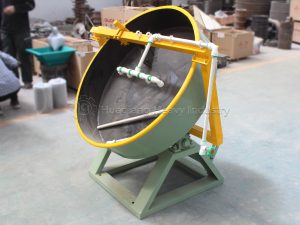
Disc granulators, with their simple structure, high granulation rate, and low energy consumption, have become core equipment in the production of organic fertilizers and compound fertilizers. Their suitability depends primarily on three indicators: the moisture content, binding properties, and particle size of the raw materials. Based on industry practice, suitable raw materials for disc granulators cover a wide range of categories, including organic waste and industrial waste residue. Precise material selection maximizes equipment efficiency and reduces production costs.
Livestock and poultry manure is a core suitable raw material for disc granulators, including chicken manure, cow manure, sheep manure, and pig manure. These raw materials are rich in nutrients such as nitrogen, phosphorus, and potassium. After composting and crushing pretreatment, a moisture content controlled at 60%-70% and a particle size not exceeding 2mm are sufficient for efficient granulation. Cow manure, in particular, has a loose texture and requires simple pretreatment, eliminating the need for additional binders; chicken manure, with its strong binding properties, requires appropriate drying to regulate humidity, resulting in a smoother surface on the granulated product.
Agricultural waste materials also show good suitability, mainly including straw, mushroom residue, and distiller’s grains. Corn and wheat straw need to be crushed and mixed with manure in a specific ratio to compensate for their insufficient binding properties. Mushroom residue and wood ear residue have moderate moisture content and a loose texture, allowing for direct granulation without much adjustment. Distillery lees and vinegar residue have excellent binding properties, achieving a granulation rate of over 85% on their own, making them high-quality auxiliary raw materials.
Industrial organic waste, such as medicinal herb residue, sugar residue, and municipal sludge, can also be used for disc granulation after treatment. Medicinal herb residue needs to be free of heavy metals before use; sugar residue requires a moisture content controlled below 65% to prevent clumping; and municipal sludge needs to be dried to a moisture content of 60%-65% and have straw powder added to adjust permeability.
In actual production, mixed raw materials are the mainstream application mode. Using a “main material + auxiliary material” ratio can solve the defects of granulation with a single raw material. It is important to avoid raw materials with excessively low moisture content, excessive binding properties, or large impurities to prevent affecting granulation results and equipment lifespan. By rationally selecting suitable raw materials and adjusting parameters, disc granulators can achieve low-cost, high-quality production, thus contributing to resource utilization.