

As a core piece of equipment in the production of organic fertilizers and compound fertilizers, the pellet forming effect of a disc granulator directly affects product quality and production efficiency. Many users encounter problems in practice, such as pellets not forming balls, being loose and brittle, or having uneven sizes, resulting in raw material waste and reduced production efficiency. In fact, these problems often stem from deviations in raw materials, equipment parameters, or operating processes. Identifying the root cause allows for efficient solutions.
Raw material characteristics are the foundation of granulation and also the most prone to problems. An imbalance in raw material moisture content is the primary cause. When the moisture content is below 18%, the raw material is dry, loose, and lacks binding force, making it difficult to agglomerate into balls; above 25%, it easily adheres to the inner wall of the disc, forming large clumps that are prone to cracking after drying. This can be tested by hand: the optimal moisture content is 20%-22% when the pellets naturally disperse after forming a ball. If it’s too dry, spray with water or a binder; if it’s too wet, add dry material to adjust. In addition, insufficient raw material viscosity or improper particle size distribution can also lead to non-spherical formation. Adding binders such as bentonite or humic acid, or incorporating 15%-25% recycled material to fill gaps, can help.
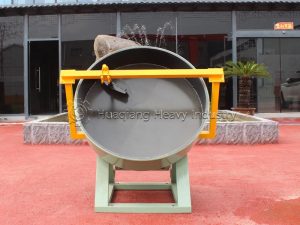
Deviation in equipment parameters is a “hardware hazard” in granulation. The disc inclination angle and rotation speed directly affect the material’s movement. Too small an inclination angle results in prolonged material residence and excessively fine particles; too large an inclination angle leads to insufficient residence time and premature discharge without sufficient agglomeration. Typically, the inclination angle for organic fertilizer granulation is controlled at 18°-22°, and for compound fertilizer at 20°-24°. Excessive rotation speed easily causes material to be thrown and broken, while too slow a rotation speed results in insufficient centrifugal force. Adjustments need to be made according to the disc diameter, generally between 10-18 r/min. Simultaneously, wear on the inner wall liner of the disc and insufficient edge height can also affect pelleting, requiring timely replacement of the liner and installation of baffles.
Improper operating procedures can also lead to non-spherical formation. Feeding too quickly or unevenly can cause material accumulation and insufficient tumbling; improper water spraying methods can result in uneven moisture distribution, localized clumping, or excessive dryness. It is recommended to feed materials at a uniform rate, using a ring-shaped atomizing spray, and replenishing water in small amounts multiple times to ensure even moisture distribution. Furthermore, an improper return material ratio will result in a lack of “seed particles,” and should be controlled between 15% and 25% to achieve resource recycling while improving the pelletizing rate.
In summary, the problem of pellets not forming properly in a disc granulator is not insurmountable. It can be quickly resolved by checking three aspects: raw material pretreatment, equipment parameter adjustment, and standardized operation. This will improve pelletizing rate and product quality, and reduce production costs.