

Windrow compost turners are core specialized equipment for the harmless treatment of organic waste and the production of organic fertilizer. Primarily relying on windrow fermentation technology, they are widely used for turning and fermenting various organic materials such as livestock manure, straw, distiller’s grains, and sludge. They are important equipment in modern agricultural environmental protection production, helping to achieve the resource recycling of waste.
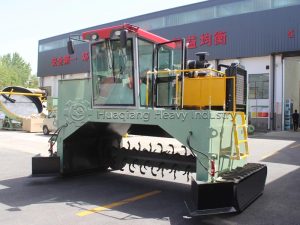
In its core application, this equipment mainly undertakes the key process of organic material fermentation. By turning, stirring, and loosening the materials, it breaks up material compaction, increases the permeability of the pile, promotes the full fermentation of aerobic microorganisms, effectively shortens the fermentation cycle, and allows the materials to mature quickly. Simultaneously, it can also handle multiple functions such as material mixing, breaking up, and uniform stacking, completely eliminating the odor produced by anaerobic fermentation inside the pile, achieving harmless and reduced-volume treatment of organic waste, and is suitable for large-scale operations in various scenarios such as farms, organic fertilizer processing plants, and agricultural parks.
Compared to traditional wheeled compost turners, windrow compost turners have many unique advantages. Firstly, they have extremely strong terrain adaptability. The widened tracks provide a large ground contact area and low ground pressure, allowing for stable operation on muddy, soft, and uneven surfaces. It can operate on slopes up to 30° without slipping or sinking, perfectly suited to the complex conditions of open-air composting sites.
Secondly, it is highly efficient and stable. Equipped with a powerful power system and a fully hydraulic control structure, the turning shaft is hydraulically adjustable to accommodate piles of varying heights and widths, covering a large area in a single operation. It can simultaneously turn, crush, and mix materials, significantly improving fermentation efficiency and shortening the traditional fermentation cycle, resulting in uniformly decomposed and high-quality organic fertilizer.
Thirdly, it is easy to operate and highly practical. The equipment supports continuously variable transmission, on-the-spot turning, a small turning radius, and high site utilization. Its intelligent and easy-to-use control design allows even beginners to quickly learn how to use it. Core components are made of wear-resistant and corrosion-resistant materials, resisting corrosion and wear from fermentation materials. The robust and durable structure results in low maintenance costs, balancing operational efficiency and economy, making it a preferred equipment for the circular development of ecological agriculture.