

Large-scale chicken farms produce large quantities of chicken manure, which, if left haphazardly, easily breeds mosquitoes and pollutes the soil and water. Traditional manual turning is inefficient, results in uneven fermentation, and makes harmless treatment difficult. As a core piece of equipment for livestock and poultry manure treatment, the windrow compost turner, with its strong adaptability, automation, and high efficiency, has become a key device for chicken manure fermentation and fertilizer production, turning chicken manure from waste into treasure and contributing to the green development of animal husbandry.
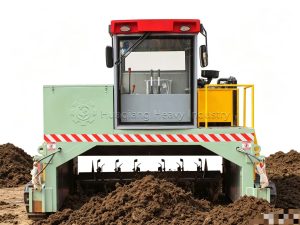
The windrow compost turner, relying on its unique tracked walking structure, is adaptable to various working sites. Unlike wheeled equipment, its tracks have a large ground contact area and low pressure, allowing it to travel smoothly on muddy, soft, open-air fermentation sites, unaffected by uneven surfaces. It eliminates the need for dedicated fermentation tanks, flexibly adapting to composting sites in farms of all sizes, significantly reducing site modification costs. During operation, the equipment straddles the strip-shaped chicken manure pile and moves forward at a uniform speed, operating entirely automatically, replacing heavy manual labor.
The chicken manure turning and fermentation process is simple and efficient. Before operation, workers mix chicken manure with straw, sawdust, and other auxiliary materials in a specific ratio, piling it into neat, long manure piles and adjusting the carbon-to-nitrogen ratio. During operation, the high-speed rotating turning roller and specially designed blades beneath the machine penetrate deep into the manure pile, shoveling, breaking up, and dropping the compacted chicken manure layer by layer, thoroughly breaking up the clumps. This process evenly mixes the materials, loosens the manure pile, and allows the internal materials to fully contact the air, providing oxygen for microbial fermentation.
Simultaneously, the turning process quickly dissipates the high temperature, moisture, and odors generated during chicken manure fermentation, effectively reducing the pile temperature and preventing problems such as burning seedlings due to high temperatures and anaerobic foul odors, while inhibiting the growth of harmful bacteria. As the equipment moves at a constant speed, the turned chicken manure will be neatly shaped, forming new, breathable manure piles that require no further processing. Following livestock manure treatment standards, daily turning and turning for seven to eight days will complete the harmless decomposition of the chicken manure.
Compared to manual turning, windrow compost turners provide more even and deeper turning, significantly shortening the fermentation cycle. The processed chicken manure is odorless and free of pathogens, and can be converted into high-quality organic fertilizer. This solves the problem of chicken manure pollution and achieves resource utilization of waste, making it an essential piece of equipment for the green and circular development of the modern livestock industry.