

Roller-press granulation is a mainstream dry granulation process in the fertilizer industry. It relies on high-pressure physical compaction to form granules. The entire process takes place at ambient temperature without the need for added water or binders, and it eliminates the need for drying or cooling stages. As a key energy-saving granulation solution promoted by Huaqiang Heavy Industry, it is widely used for producing granular fertilizers, such as compound fertilizers and NPK fertilizers.
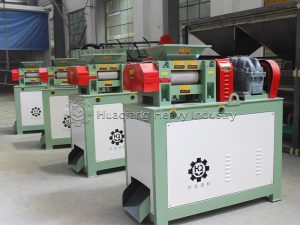
The complete granulation process consists of five stages: raw material pretreatment, forced feeding, high-pressure compaction, crushing and granulating, and screening/recycling. First, raw materials—such as fermented/matured organic fertilizer and NPK components—are pulverized and mixed. The moisture content is adjusted to an optimal range, and any iron fragments or hard impurities are removed to ensure a fine, uniform powder; this prevents hard objects from damaging the roller surfaces and ensures stable forming.
The prepared powder mixture is continuously fed by a feeding device into the gap between two counter-rotating pressure rollers, which feature patterned grooves on their surfaces. As the material enters the “nip” (compression) zone, it undergoes plastic deformation under continuous pressure, becoming compacted into dense sheets or pillow-shaped briquettes. As the rollers continue to rotate, the pressure is released, and the briquettes are automatically discharged into a crushing and granulating mechanism below, where they are sheared and broken down into irregular granular particles.
The semi-finished granules are then sent to a vibrating screen for classification. Granules that meet the required specifications are transported to a finished-product silo for packaging, while fine powder and small fragments are recycled back into the mixing stage to be re-granulated with fresh raw materials. This creates a closed-loop production process that effectively reduces raw material waste and improves material utilization.
This process offers significant advantages. Because it is a dry, ambient-temperature forming method, it preserves the integrity of organic matter and the activity of beneficial microorganisms, ensuring the stability of fertilizer nutrients. Furthermore, the process is streamlined, consumes far less energy than wet-type pan granulation, generates no wastewater or exhaust gas, and is highly environmentally friendly. This equipment accommodates a wide range of raw materials. The roller shells can be customized with specific die patterns, allowing for easy adjustment of granule size and strength. The resulting granules feature high hardness, excellent resistance to crumbling, and superior storage and transport characteristics.
Naturally, the process requires careful control: raw material moisture content, feed uniformity, the gap between the pressure rollers, and the applied extrusion force all directly influence the granulation rate and granule strength. Insufficient pressure leads to loose, unstable granules, while excessive pressure accelerates wear on the roller shells. Maintaining stable process parameters, combined with an optimal ratio of recycled material (fines), is key to ensuring continuous, steady output from the production line. Given the current trend toward eco-friendly fertilizer production, roller-press granulation has become the preferred choice for small- and medium-scale fertilizer production lines, thanks to its low capital investment, low energy consumption, and ease of operation and maintenance.