

Extrusion granulation is a dry-forming process that requires minimal water addition, eliminating the need for a drying stage; it is a mainstream choice for the production of organic and compound fertilizers. Huaqiang Heavy Industry offers both flat-die and roller-press extrusion granulators—both are popular models, yet they differ significantly in terms of structure, the shape of the output, and the types of materials they can process. Selecting the right equipment is essential for achieving stable production output and minimizing operational costs.
A flat-die pellet machine utilizes pressure rollers that rotate over a horizontal die plate, forcing material through the die holes to produce cylindrical granules. Its primary advantage is its strong compatibility with high-fiber materials. It performs exceptionally well with feedstocks such as fermented chicken manure, straw, mushroom residue, or distillers’ grains—materials often characterized by high fiber content and inconsistent stickiness. It yields a high granulation rate, produces dense, durable granules that resist crumbling, and helps preserve the activity of beneficial microorganisms. It also accommodates a wider range of moisture content, making it the preferred choice for small-to-medium-scale organic fertilizer plants or production lines that primarily process organic waste. Its drawbacks include relatively rapid die wear and a lower maximum capacity per unit, making it best suited for small-to-medium-sized projects.
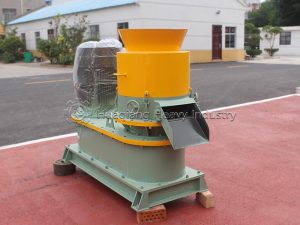
A double roller-press granulator uses two counter-rotating rollers equipped with recessed pockets to compress material into flattened, spherical granules. The roller shells are replaceable, maintenance is straightforward, and the system offers high stability for continuous production. This type is better suited for fine, uniform, and low-fiber powdered materials—such as NPK compound fertilizers, inorganic mineral powders, or potash fertilizers. It enables direct granulation of dry powders with minimal “recycled material” (fines/oversize), offers higher per-unit output, and is ideal for large-scale compound fertilizer production lines or projects involving inorganic fertilizers with stable formulations. Its limitation is that materials with high fiber content tend to slip, resulting in poor granule formation and a significant drop in the granulation rate.

In summary, the selection logic is as follows: If your raw materials consist primarily of high-fiber organic matter—such as livestock and poultry manure, straw, or mushroom residue—and you prioritize granule hardness and the appearance of the final product, while operating at a modest production scale, a flat-die pellet machine is the better choice. For production processes primarily utilizing finely powdered inorganic fertilizers or mineral powders—where the formula is stable and large-scale, continuous production is planned—a double roller extrusion granulator is the ideal choice.
When selecting equipment, one must consider not only the raw materials but also the required production capacity, available space, and budget. Both types of equipment rely on a physical, low-temperature extrusion process that requires no binders, resulting in a clean, compliant finished product. Huaqiang Heavy Industry can recommend the most suitable model based on test results from your raw material samples; this helps prevent issues such as poor granule formation or insufficient capacity that might otherwise arise from an uninformed purchase. A well-configured equipment setup is essential for ensuring the stable operation of a fertilizer production line and enhancing the competitiveness of the final product.