

Large Angle Belt Conveyor
This series of products is mainly suitable for high inclined continuous conveying of bulk materials. With the conveyor belt with corrugated side plate and diaphragm plate, the transmission angle is 0 ~ 90.
DETAILS
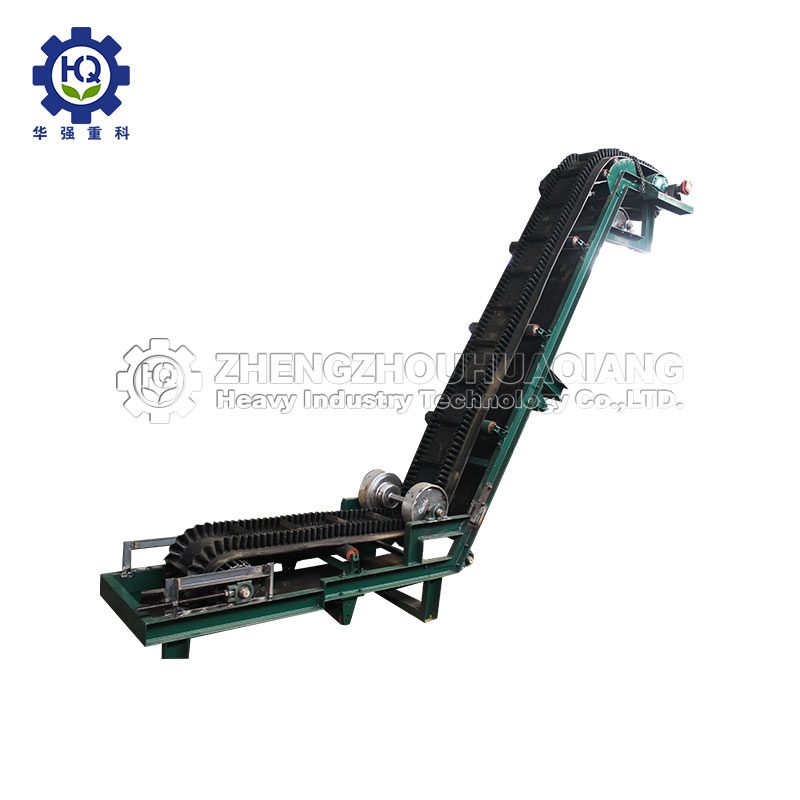
Large angle belt conveyors utilize flexible, vertically corrugated rubber “sidewalls” attached to both sides of a flat rubber conveyor belt, with transverse cleats of specific strength and elasticity bonded between them to form individual “box-like” compartments. Materials are enclosed within these compartments as they travel with the belt, enabling stable transport at steep angles or even in a vertical orientation.
How does a large angle belt conveyor transport materials?
The entire conveyor belt of a large angle belt conveyor loops around the drive and bend pulleys at both ends to form a closed circuit; a tensioning device at the tail maintains proper belt tension, while idlers provide support along the length of the belt.
When the drive unit rotates the drive pulley, friction between the pulley and the belt propels the belt forward. After material is fed onto the belt via the loading chute, it is securely contained within “pocket-like compartments” formed by corrugated sidewalls and transverse cleats; as the belt moves, the material is transported to the discharge unit at the head end for unloading. It is precisely this “pocket-style” load-bearing structure that prevents the material from sliding back down the steep slope due to gravity.
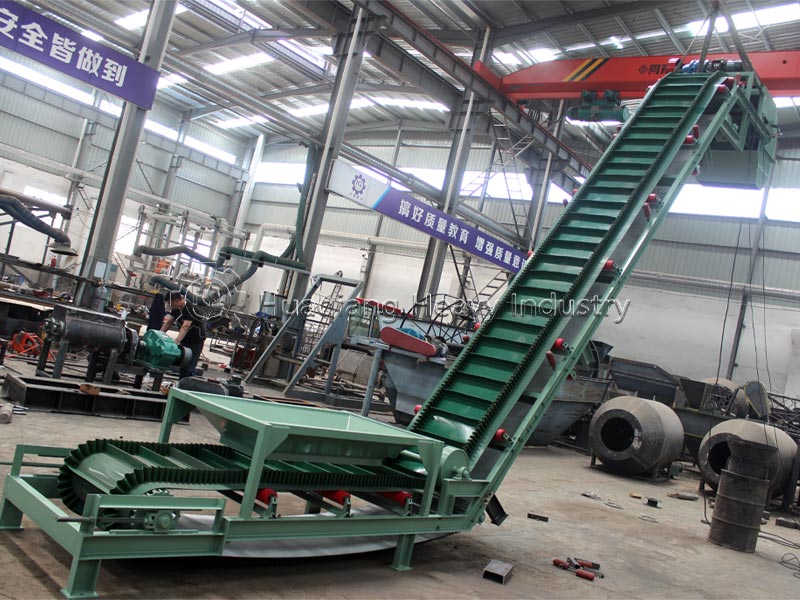
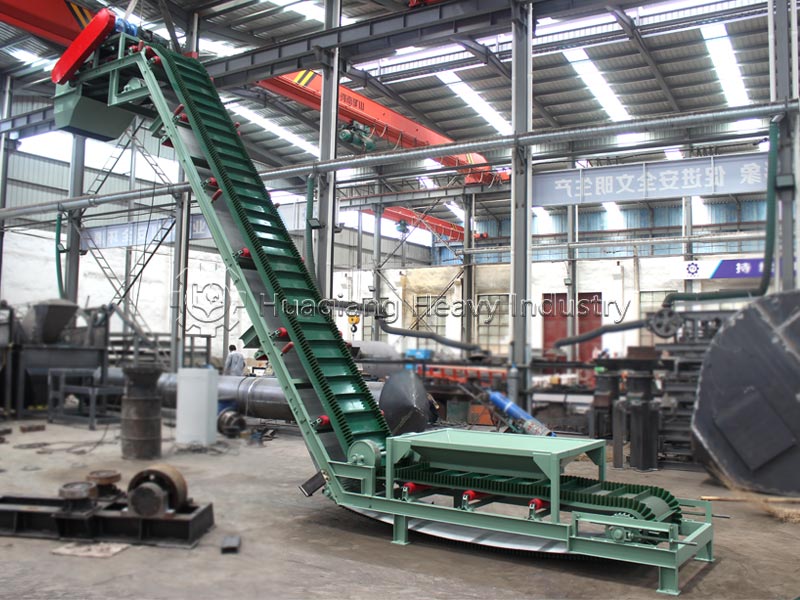
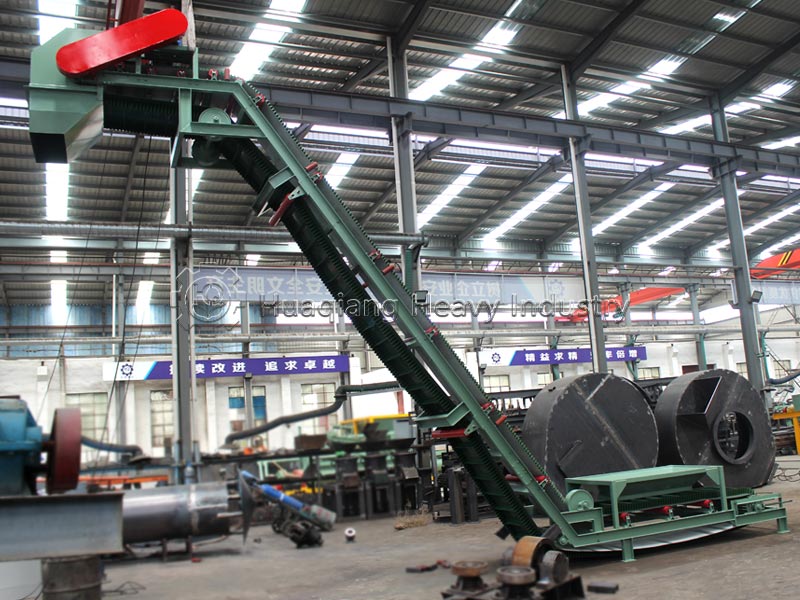
The conveyor typically employs a “Z-shaped” configuration, comprising an upper horizontal section, a lower horizontal section, and an inclined section; material is loaded at the lower horizontal section and discharged at the upper horizontal section. Convex and concave curved frame sections connect the horizontal sections to the inclined section, ensuring a smooth transition for the conveyor belt.
What are the structural components of a large angle belt conveyor?
The structure of a large angle belt conveyor is not complex; its core components include the following:
Corrugated sidewall conveyor belt: The most critical component, consisting of a base belt, corrugated sidewalls on both sides, and transverse cleats. The base belt handles traction and load-bearing functions; the corrugated sidewalls prevent material spillage from the sides; and the transverse cleats serve to separate and support the material.
Drive unit: Comprising an electric motor (typically the Y-series) and a speed reducer (such as the ZJ-type shaft-mounted reducer), this serves as the power source for the entire machine. The installation levelness of the drive unit must be controlled within a tolerance of 0.5 mm.
Drive pulley and bend pulley: The drive pulley typically features a rubber-lagged surface to enhance traction with the conveyor belt. The bend pulley is used to alter the running direction of the conveyor belt.
Idlers and frame: Idlers arranged along the length of the conveyor belt support the belt and the material, thereby reducing running resistance. The frame is equipped with low, medium, or high intermediate support legs, depending on the layout requirements.
What are the advantages of large angle belt conveyors?
Breakthrough Conveying Angles
While traditional belt conveyors are limited to an inclination of ≤18°, high-inclination models raise this limit to a full 90°.
High Component Compatibility
Core components—such as drive pulleys, idlers, and tensioning devices—are fully compatible with standard belt conveyors. Users do not need to stock large quantities of specialized spare parts, significantly reducing downtime caused by parts shortages.
High Conveying Efficiency
The “pocket” structure formed by corrugated sidewalls and transverse cleats effectively contains the material, preventing spillage. Under identical operating conditions, conveying capacity can be 1.5 to 2 times higher than that of standard equipment.
Low Energy Consumption
There is no internal or external material friction resistance during operation. The idler assemblies utilize a rolling friction design, reducing operating resistance by over 30% compared to traditional equipment and delivering significant energy savings during long-term operation.