

A: Disc granulation is a wet agglomeration process; material moisture content is the critical factor determining the quality and rate of granule formation. Strict moisture control is essential, as levels that are too high or too low directly impact production outcomes and prevent the creation of compliant granules.
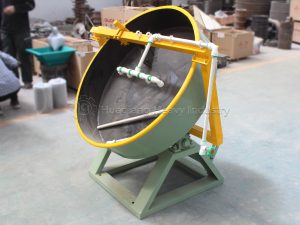
For standard organic fertilizer and compound fertilizer materials, the optimal moisture content generally ranges from 25% to 35%, though this varies slightly depending on the specific raw materials. For organic materials such as livestock manure, straw powder, and biogas residue, the ideal moisture content is 28%–32%; at this level, the material exhibits moderate adhesiveness and excellent rolling agglomeration, resulting in round, compact, and durable granules. For materials like chemical powders, humus soil, and bentonite, moisture can be fine-tuned to 25%–28% to prevent the granules from becoming overly wet and sticking together.
If the moisture content is too low, the powder lacks sufficient adhesiveness to agglomerate effectively, leading to poor granulation rates, excessive loose powder, and fragile granules, which significantly reduces the yield of finished product. Conversely, if the moisture content is too high, the material will stick to the disc and clump together, resulting in uneven granule sizes, material blockages, and disc fouling; it also places an excessive load on the subsequent drying stage, thereby increasing production costs.
During production, moisture levels must be fine-tuned based on raw material characteristics—involving uniform water spraying and thorough mixing—to ensure consistent moisture distribution. This is essential for maintaining stable, continuous operation of the disc granulator and producing high-quality granules with uniform appearance.