

Fertilizer compost turners are core equipment in organic fertilizer fermentation production, mainly used for material mixing, oxygenation, and heat dissipation, accelerating the composting of raw materials such as manure, straw, and mushroom residue. The mainstream compost turners on the market are divided into three main categories: trough type, tracked type, and disc type. These three types differ significantly in structural design, operating scenarios, suitable materials, and production efficiency, catering to different scales of fertilizer production needs.
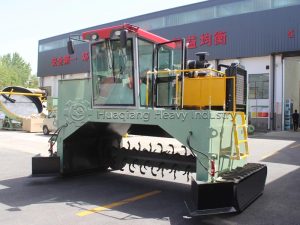
Trough type compost turners are the mainstream equipment for standardized plant fermentation, requiring a fixed fermentation trough and track for operation. The equipment moves at a uniform speed along the track, turning materials through a spiral or chain plate structure. It features structural stability, a high degree of automation, and can achieve timed and quantitative turning operations. It occupies a small area, provides a closed and clean fermentation environment, effectively reducing odor diffusion, and is suitable for high-moisture, high-viscosity materials such as livestock and poultry manure. It is suitable for large and medium-sized standardized organic fertilizer production lines. However, this equipment requires prior construction of supporting infrastructure, resulting in higher initial investment costs and less site flexibility.
Windrow compost turners are mobile equipment that requires no fixed tracks or fermentation tanks, moving only by tracks. They are suitable for various irregular sites such as open fields and greenhouses. The equipment is highly mobile, able to turn and move freely, flexibly adjusting the work area without requiring complex infrastructure, resulting in low initial investment. During operation, it can simultaneously crush, mix, and oxygenate materials, making it highly versatile and suitable for various common raw materials such as straw, manure, and sludge. It is particularly suitable for small and medium-sized farms, individual farmers, and production scenarios with limited space. Its disadvantages include slightly lower operating precision and lower efficiency for large-scale production compared to trough-type equipment.
Large Wheel-type compost turners are high-efficiency equipment for large-span, deep composting. Their core advantages lie in their wide operating range and depth. They can compost spans up to 30 meters and depths up to 3 meters, processing large volumes of material per operation with lower energy consumption. This equipment is suitable for large-scale centralized fermentation sites, ideal for the large-volume fermentation of low-viscosity materials, significantly improving production efficiency. However, these machines are bulky, only suitable for a limited range of materials, and have high requirements for material moisture and viscosity. Highly viscous materials are prone to incomplete turning, limiting their applicability to specific scenarios.
In summary, each of the three types of turning machines has its advantages and disadvantages. For standardized mass production, choose the trough type; for flexible, niche production, choose the windrow type; and for ultra-large-scale fermentation of lightweight materials, choose the large wheel type. Selecting the appropriate model based on specific needs maximizes fermentation efficiency and reduces production costs.