

In the production of organic and compound fertilizers, the granulation process directly determines the appearance and quality of the final product, as well as the investment required for the production line. Common granulation methods on the market include rotary drum granulation and roller extrusion granulation. Disc granulation, which utilizes a unique agglomeration-based pelletizing principle, has become a highly favored choice for organic fertilizer production lines supplied by Huaqiang Heavy Industry, offering several distinct advantages over other processes.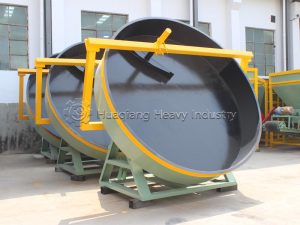
The most immediate benefit of disc granulation is the superior appearance of the finished granules. Unlike roller extrusion, which produces flattened, ovoid-shaped particles, disc granulation relies on the rotation of an inclined disc; materials roll and layer upon one another to form granules that are round, plump, and smooth-surfaced. The particle size is controllable, and the pelletizing process is highly stable. These rounded granules offer excellent flowability—preventing clogs in fertilizer spreaders—and break down evenly in the soil, making them highly preferred in the agricultural inputs market. Furthermore, compared to rotary drum granulation, the material inside the disc remains visible throughout the process. Operators can directly monitor the formation of the granules and make real-time adjustments to water spray volume, disc inclination, and rotation speed, allowing for faster response times in particle size regulation and a lower learning curve for setup.
Additionally, disc granulation requires lower capital investment, occupies less space, and is easier to operate and maintain. Rotary drum granulation systems are typically massive and involve complex auxiliary equipment, leading to higher infrastructure and procurement costs. Roller extrusion systems, meanwhile, rely on roller shells—components prone to wear—which incur significant replacement costs over time. In contrast, disc granulation features a simple structure, consisting primarily of the disc, scrapers, and a drive assembly. With fewer wear-prone parts, easier installation, and lower energy consumption, it is an ideal choice for small-to-medium-sized fertilizer processing plants. Operators can become proficient with minimal training, and the requirements for daily cleaning and maintenance are minimal, resulting in lower long-term operational pressure.
Finally, because disc granulation is a room-temperature, wet-agglomeration process, it is highly effective at preserving the activity of organic fertilizers. The formation process involves neither high-pressure compression nor high-temperature heating; consequently, heat-sensitive components—such as microbial inoculants and organic matter—remain intact, ensuring the biological activity of the organic fertilizer is maintained. Roller compaction relies on high-pressure forced molding, which often leads to the inactivation of microorganisms; drum granulation, meanwhile, frequently incorporates steam heating, which can also result in the loss of certain beneficial bacteria. Disc granulation, by contrast, is highly versatile—it is well-suited for a variety of raw materials with moderate adhesiveness, such as composted livestock and poultry manure, humic acid, and various powdered compound blends.
Naturally, disc granulation has its limitations: it is quite sensitive to the moisture content of the raw materials, and the finished product requires a subsequent drying process. Furthermore, for large-scale, ultra-high-capacity projects, drum granulation is generally a more suitable choice. Overall, if the priorities are the commercial quality of the granules, the control of initial capital investment, and the flexibility to adjust formulations, disc granulation offers an excellent price-to-performance ratio, making it the preferred granulation method for small and medium-sized fertilizer projects.