

A disc granulation production line is a standard set of equipment used for processing organic and compound fertilizers. It relies on the rolling motion of materials to cause them to agglomerate into spherical granules. The entire production line—from initial processing to final packaging—is an integrated, interconnected system. The disc granulation production line designed by Huaqiang Heavy Industry consists of five main modules: raw material pre-treatment, batching and mixing, granulation, post-treatment, and auxiliary conveying. The functions of the equipment in each module are described below.
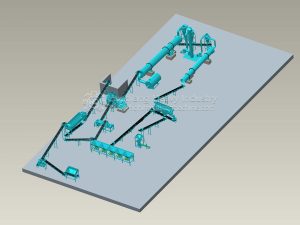
In the raw material pre-treatment stage, the core piece of equipment is the half-wet material crusher. Raw materials such as fermented livestock manure or crop straw often contain clumps; the crusher breaks these down to the appropriate fineness and removes hard impurities, ensuring a smooth granulation process. A feed loading hopper, serviced by a loader, is used to store raw materials and provide a stable, continuous feed to the line.
The batching and mixing unit includes an automatic batching system and a twin-shaft paddle mixer. The automatic batching system precisely measures various raw materials according to a specific formula, ensuring consistent nutrient content in the fertilizer. The twin-shaft paddle mixer thoroughly blends the powdered materials, microbial agents, and binders, ensuring uniform moisture and composition—a crucial foundation for granulation. Once mixed, the material is transported via a belt conveyor to the main granulation unit.
The disc granulator is the core equipment of the entire production line. By adjusting the tilt angle and rotational speed of the disc—while simultaneously adding water via a spray system—the powdered material is made to roll continuously within the disc. As the material layers upon itself, it gradually forms spherical granules. The disc also acts as a classifier: granules that reach the desired size automatically spill out, while smaller particles remain in the disc to continue growing. This process results in a high granulation rate and produces well-rounded, uniform granules.
The wet granules produced by the granulator must be dried and cooled, passing first through a drum dryer and then a drum cooler. The dryer removes moisture at a low temperature, which prevents the granules from molding during storage; the cooler rapidly lowers the temperature, increasing the hardness of the granules and reducing the risk of breakage. These two stages ensure the physical quality of the final product.
Finally, the material is fed into a rotary screening machine, which separates the finished, properly sized granules from fine powder and oversized clumps. Fines and oversized materials are returned to the granulation stage for reprocessing, while granules that meet specifications can, if required, be routed to a coating machine to receive an anti-caking protective layer, thereby extending their shelf life. Finally, an automatic packaging machine handles precise weighing and sealing, producing the finished, bagged fertilizer.
The entire production line relies on belt conveyors and bucket elevators for the continuous transport of materials. It is also equipped with a pulse-jet dust collection system to capture airborne dust, ensuring compliance with environmental protection standards. The disc granulation production line offers flexible equipment configuration—allowing for capacity-based scaling—and features stable operation and a moderate investment cost, making it the preferred choice for small to medium-sized fertilizer plants.