

The disc granulator is a classic piece of equipment for the wet granulation of organic fertilizer. It operates by rotating an inclined disc, causing materials inside to roll and agglomerate into spherical granules. It is widely used in small-to-medium-scale organic fertilizer production lines. Drawing on years of industry experience, Huaqiang Heavy Industry has outlined the advantages and drawbacks of using disc granulators, providing a useful reference for organic fertilizer plants during the equipment selection process.
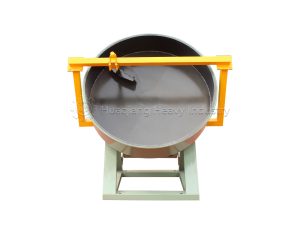
The advantages of the disc granulator are significant. First, it features a simple structure—consisting of a disc, a frame, a drive system, and a scraper—which ensures low initial investment, easy installation and commissioning, and minimal daily maintenance. It has a low technical threshold for operators, allowing even beginners to become proficient after basic training. Second, it produces high-quality, spherical granules with a smooth, full appearance. The granulation rate can reach 70%–90%, and the granule size is adjustable, resulting in an attractive product that is well-suited for the market. As a wet-granulation process conducted at ambient temperature, it avoids high heat, effectively preserving the activity of beneficial microorganisms and the integrity of organic matter—making it ideal for the production of bio-organic fertilizers. The equipment is highly flexible; by adjusting the disc’s inclination angle, rotational speed, and water spray volume, operators can easily control granule size. It is compatible with a wide range of decomposed organic raw materials, such as livestock and poultry manure, straw, and fungal residue, and allows for convenient production line modifications.
However, the disc granulator also has clear limitations. The process imposes strict requirements on the moisture content of the raw materials—ideally kept around 30%. If the moisture is too high, the material tends to stick to the disc; if it is too low, it becomes difficult to form granules. Consequently, significant pre-processing of the raw material is often required. The capacity of a single unit is limited, making it better suited for small-to-medium-scale projects; large-scale facilities would require multiple units operating in parallel, which increases space requirements and auxiliary costs. Furthermore, because the granules produced via wet granulation have a high moisture content, a drying stage is necessary, which adds to energy consumption and operational costs. Finally, the finished granules have relatively low structural strength, making them prone to breakage during long-distance transport; this results in a higher proportion of “recycled” material (fines or broken granules) that must be screened out and reprocessed. The disc granulator features an open structure; since the production process generates dust, appropriate dust-removal and environmental protection equipment must be installed in the workshop. Furthermore, the raw materials require a certain degree of adhesiveness; materials with excessively high fiber content or poor natural adhesiveness are difficult to granulate and will necessitate the addition of a binding agent.
Overall, the disc granulator—characterized by a lower initial investment and the production of granules with an attractive appearance—is a preferred choice for small to medium-sized organic fertilizer plants. For large-scale organic fertilizer projects, or in scenarios involving raw materials with poor adhesiveness where high granule strength is required, it is advisable to evaluate alternative granulation equipment to determine the most suitable processing solution.