

With the advantages of a wide range of compatible raw materials and flexible formula adjustments, disc granulation production lines serve as the mainstream solution for manufacturing organic fertilizers and organic-inorganic compound fertilizers. Disc granulation equipment from Huaqiang Heavy Industry can process three main categories of powdered materials: organic raw materials, inorganic raw materials, and auxiliary binding agents. By combining these materials in various ways, it is possible to produce granular fertilizers with specific nutrient profiles.
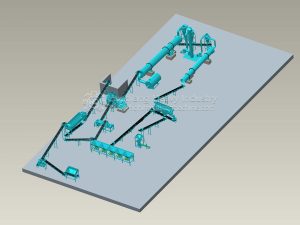
Organic raw materials are the primary components used in disc granulation, with a preference for materials that have undergone thorough fermentation and decomposition. Livestock and poultry manure—such as that from chickens, cattle, pigs, or sheep—are core ingredients; once decomposed, they develop natural adhesiveness, making them easy to granulate while providing a high organic matter content. Agricultural waste is also abundant; materials like straw powder, rice husk powder, peanut shell powder, sawdust, mushroom residue, biogas residue, distillers’ grains, medicinal residue, and oil-seed cakes can all be utilized. These materials are typically high in fiber, which helps improve the permeability of the raw material mix and balance the carbon-to-nitrogen (C/N) ratio. Humic acid, peat, and safely treated sludge are also high-quality organic inputs, particularly useful for enhancing the soil-improving properties of the fertilizer. Before granulation, organic materials must be pulverized to a controlled fineness, and their moisture content must be kept within an optimal range to prevent clumping, which could otherwise hinder the formation of granules.
Inorganic raw materials are primarily used to supplement essential macronutrients—nitrogen (N), phosphorus (P), and potassium (K)—and are commonly employed in the production of compound fertilizers and organic-inorganic mixed fertilizers. Nitrogen sources typically include urea, ammonium sulfate, ammonium chloride, and ammonium bicarbonate; phosphorus sources include monoammonium phosphate (MAP), diammonium phosphate (DAP), ordinary superphosphate, and triple superphosphate; while potassium sources mainly consist of potassium chloride and potassium sulfate. Since inorganic powders generally lack natural adhesiveness and are difficult to granulate on their own, they are typically blended with organic powders. This allows for the adjustment of nutrient ratios to meet the specific fertilization requirements of various cash crops and field crops.
Auxiliary materials and binding agents are crucial for ensuring effective granulation; they are often added in appropriate amounts when the primary raw materials lack sufficient adhesiveness. Bentonite and attapulgite are commonly used binders in the industry; they are effective even at low inclusion rates, ensuring stable granulation, enhancing granule strength, and reducing the amount of material that needs to be reprocessed. Some formulations may also incorporate molasses or lignosulfonates as supplementary binders. Water serves as the primary liquid phase, applied uniformly via a spray system to regulate material moisture, which facilitates the rolling and agglomeration of fine powders into spherical granules.
The selection of raw materials directly determines granulation efficiency and the quality of the final product. Uncomposted manure, large or hard debris, and materials with high impurity content are not suitable for direct processing in a disc granulator. Huaqiang Heavy Industry’s disc granulation production lines allow clients to flexibly select and proportion raw materials based on local resource availability and specific product positioning. This enables the production of high-quality, uniformly spherical, and structurally stable fertilizer granules—helping projects lower raw material procurement costs while transforming agricultural waste into valuable resources.