

In the production of organic fertilizer and the resource recovery of livestock manure and organic waste, the composting equipment used directly determines fermentation quality, production capacity, and operating costs. Thanks to its unique structural advantages, the large-wheel compost turner has become the preferred choice for large-scale fermentation projects; this specific model from Huaqiang Heavy Industry is widely utilized by numerous large-scale organic fertilizer plants and sludge treatment facilities.
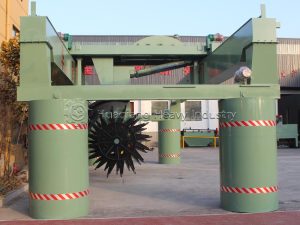
The most prominent advantages of the large-wheel compost turner are its extensive working span and significant operating depth. Compared to conventional trough-type turners, it can cover a width of several tens of meters and reach a depth of up to 3 meters, allowing a single unit to service a wide fermentation trough. This enables higher material stacking within the same facility footprint, significantly improving space utilization. It eliminates the need for constructing multiple narrow fermentation troughs, thereby substantially reducing civil engineering costs and shortening project construction timelines. As the wheel rotates, it lifts material from the bottom and tosses it upward, breaking up clumps and ensuring thorough contact with the air. This provides uniform oxygen distribution, eliminates “dead zones” within the fermentation trough, and prevents issues such as anaerobic decomposition, foul odors, or uneven maturation of the material at the bottom.
The consistent and uniform turning action effectively accelerates the aerobic fermentation process. An ample oxygen supply promotes microbial proliferation, while the temperature of the compost pile remains controllable. This reduces the maturation cycle from the traditional 30-plus days to just 15–20 days, leading to a significant boost in production capacity. The turning process also functions as a shredder, breaking up compacted material and easing the workload for subsequent screening and granulation stages. The resulting organic fertilizer is of consistent quality, and the high-temperature fermentation process eliminates insect eggs and harmful pathogens, ensuring a safer end product.
From an operational perspective, the large-wheel compost turner is well-suited for large-scale, continuous production. It supports remote-controlled, automated movement, which minimizes the need for on-site manual supervision and lowers labor costs. The wear-resistant turning tines are easy to replace, simplifying maintenance, while the robust overall structure is designed for long-term, continuous operation. This equipment is highly versatile, capable of processing a wide range of raw materials—including livestock and poultry manure, crop straw, mushroom cultivation residue, municipal sludge, and fruit pomace. A single production line can flexibly handle various types of organic solid waste, meeting the diverse processing requirements of environmental resource-recovery projects.
In an era of increasingly stringent environmental regulations, uniform turning of the compost pile helps minimize the buildup of foul odors, thereby reducing the burden on exhaust gas treatment systems. For clients planning to expand production or construct new, large-scale organic fertilizer facilities, the large-wheel compost turner offers an optimal balance of production capacity, product quality, infrastructure investment, and long-term operational costs—making it a highly cost-effective solution for large-scale aerobic fermentation processes.