

In aerobic fermentation projects for organic fertilizer and the resource utilization of livestock and poultry manure, both large wheel type and trough-type compost turners are mainstream pieces of equipment. Clients often find it confusing to choose between them. Huaqiang Heavy Industry has outlined the core differences to help you make an informed selection based on your production capacity, site conditions, and budget.
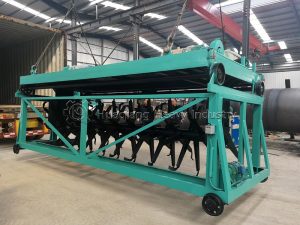
Regarding their structural design and operating principles, a trough-type compost turner utilizes a rotating drum to turn the material. It travels longitudinally along rails installed on both sides of a fermentation trough, with the drum continuously agitating the contents—lifting material from the bottom to facilitate oxygenation and heat dissipation. These machines typically offer a working depth of 0.8–1.8 meters and a relatively narrow working width, making them well-suited for narrow-trough layouts. In contrast, a large wheel compost turner employs large, rotating discs equipped with tines. These discs cut vertically into the material pile, using centrifugal force to lift and break up the material from the bottom. They can reach working depths of 1.5–3 meters, cover a wider span, are more effective at breaking up compacted clumps, and offer a significantly higher processing capacity per pass than standard trough-type compost turners.
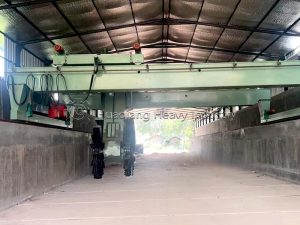
The most significant differences lie in site infrastructure and initial investment. Trough-type compost turners require the construction of concrete fermentation troughs and side rails, which entails substantial civil engineering work and higher upfront infrastructure costs. However, the troughs can be designed with features such as impermeable linings, leachate collection systems, and odor-containment enclosures. This makes it easier to collect and treat wastewater and odors, simplifying environmental compliance—an ideal solution for small-to-medium-scale organic fertilizer plants facing strict environmental regulations. Large wheel compost turners are designed for wide-span fermentation troughs. For a given production capacity, they require fewer individual troughs and eliminate the need for numerous partition walls, resulting in higher land-use efficiency. On the other hand, these machines are heavier, requiring facilities with higher load-bearing capacities; they also carry a higher individual purchase cost. Consequently, they are better suited for large-scale, continuous-production facilities with an annual output of 50,000 tons or more. In terms of production efficiency and operational flexibility, a trough-type compost turner can be paired with a transfer carriage to serve multiple fermentation troughs, ensuring high equipment utilization and lower energy consumption. This configuration is well-suited for stable, batch-based fermentation processes; it is easy to maintain and uses highly interchangeable components. Conversely, a large wheel compost turner offers high single-unit processing capacity, rapid turning speeds, and an extensive coverage area, making it ideal for the centralized, large-scale fermentation of bulk materials. However, its disc-harrow teeth are prone to faster wear, it consumes more energy, and it requires more space for maintenance. For smaller-scale operations, such equipment may lead to overcapacity and unnecessary costs.
Regarding application scenarios, trough-type compost turners are best suited for small-to-medium-sized farms or sludge treatment facilities—typically handling materials like chicken manure, distillers’ grains, or mushroom cultivation waste—where the priority is low initial investment and stable, reliable operation. Large wheel compost turners are better suited for large-scale waste treatment centers or industrial organic fertilizer plants, where high volumes of material and shorter composting cycles necessitate high-capacity, intensive production.
In summary, if your priorities include lower infrastructure investment, enclosed (environmentally controlled) processing, and small-to-medium production capacity, a trough-type compost turner is the preferred choice. If you require a wider span, deeper material piles, high throughput, and a reduction in the civil engineering costs associated with constructing fermentation troughs, a large wheel compost turner is the better option. Selecting the right equipment is essential to ensuring stable fermentation and effectively managing overall operational costs.