

In the process of resource recovery and treatment of manure from large-scale livestock and poultry farms, the composting equipment used is a decisive factor in the success of aerobic fermentation. Many agricultural enterprises often ask: Is a large wheel compost turner suitable for fermenting livestock and poultry manure? The answer is a definitive yes. It is a primary piece of equipment for trough-based aerobic fermentation of various types of manure—such as that from pigs, cattle, or chickens—and is particularly well-suited for medium-to-large-scale manure treatment projects and organic fertilizer production lines.
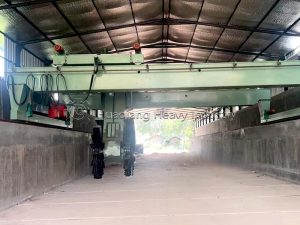
Livestock and poultry manure is typically highly viscous and has a high moisture content. When piled up, it tends to become compacted and oxygen-deprived, leading to foul odors, stalled fermentation, and uneven decomposition. Equipped with large-diameter rotating discs featuring wear-resistant tines, this type of turner can reach the very bottom of the material pile. It lifts, breaks up, and scatters the manure, performing crushing, aeration, mixing, and cooling in a single pass. By effectively breaking apart manure clumps, it ensures that oxygen penetrates deep into the pile, creating a stable environment for aerobic microorganisms. This accelerates the decomposition of organic matter and shortens the fermentation cycle, while the high temperatures generated help eliminate parasite eggs and pathogens, ensuring the manure is rendered harmless.
Compared to traditional turning equipment, the large wheel compost turner excels in its wide span and deep-turning capability. A single unit covers a larger working width and reaches greater depths, resulting in higher space utilization within the fermentation troughs and lower civil engineering costs. Furthermore, it minimizes “dead zones” within the trough, preventing localized anaerobic conditions that cause foul odors. The equipment supports automated control and scheduled turning, meaning operators do not need to spend long periods inside the fermentation facility. This reduces labor requirements and makes the system ideal for continuous, large-volume manure processing. It is also one of the key pieces of equipment for large-scale manure fermentation promoted by Huaqiang Heavy Industry.
However, its suitability is not unconditional. If the moisture content of the manure is too high, it must first be adjusted by adding bulking agents—such as straw or sawdust—to prevent the material from sticking to the discs and compromising the turning efficiency. This model is better suited for processes utilizing fixed fermentation tanks, as well as for small-scale operations or projects with limited space; therefore, careful comparison is advised during the selection process.
Overall, provided that the supporting process is well-designed—with proper management of moisture content and the carbon-to-nitrogen (C/N) ratio—the large wheel compost turner is highly effective for the fermentation of livestock and poultry manure. It addresses common challenges such as material compaction, insufficient oxygen supply, and uneven fermentation. By facilitating both environmental compliance and the production of organic fertilizer, it serves as an ideal turning solution for the resource utilization of manure on large-scale livestock farms.