

A double roller press granulator is a dry-granulation device that requires neither the addition of water nor a drying process; instead, it relies on the inherent plasticity of the powder to form granules through extrusion. Due to its versatility in handling various raw materials and its simple process, it is widely used in industries such as fertilizers, chemicals, and mining. The equipment manufactured by Huaqiang Heavy Industry can process hundreds of different powdered materials, provided they meet two basic criteria: they must be in a dry-powder state and possess a certain degree of plasticity. Ideally, the moisture content should be controlled between 8% and 12%.
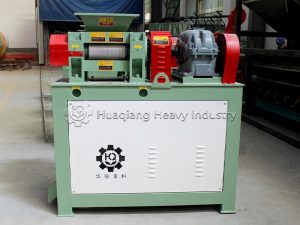
Fertilizers represent the primary category of materials processed by this equipment. Raw materials for inorganic compound fertilizers—such as potassium chloride, potassium sulfate, ammonium chloride, ammonium sulfate, monoammonium phosphate (MAP), diammonium phosphate (DAP), and urea—can be blended directly to produce NPK compound fertilizers, binary fertilizers, or high-potassium fertilizers. This approach overcomes common issues associated with traditional drum granulation, such as material clogging and the difficulty of adjusting formulas. For organic fertilizers, materials like fully fermented and pulverized livestock/poultry manure, humic acid, peat, fungal residue, traditional Chinese medicine residue, and dried distillers’ grains are all suitable. Pre-pulverizing these raw materials to approximately 80 mesh ensures stable granulation and uniform granule strength, making the final product easy to package, store, and spread.
Beyond fertilizers, the equipment is also well-suited for various chemical powders. Dry materials such as industrial salt, de-icing agents, bentonite, activated carbon, zinc oxide, rare-earth mineral powder, gypsum powder, fly ash, and graphite powder can be granulated using this method, which helps reduce dust emissions and facilitates transport and application. Feed additives and certain powdered environmental-treatment agents are also compatible; the system allows for easy formula changes, making it ideal for multi-variety, small-batch production.
However, not all powders are suitable for roller extrusion granulation. Materials that are highly moist, highly viscous, contain excessive coarse fibers, or have extremely poor flowability tend to stick to the rollers or fail to release properly, resulting in poor granulation. Conversely, dry powders with insufficient moisture or a complete lack of plasticity will produce loose, fragile granules with a very low formation rate. When selecting equipment, in addition to identifying the type of material, it is essential to assess its fineness, moisture content, and abrasiveness. For highly hard or abrasive mineral powders, the equipment can be fitted with wear-resistant roller shells to extend its service life. Leveraging the advantages of dry-process forming, the Huaqiang Heavy Industry double roller press granulator is well-suited for granulating fertilizers and chemical powders. It serves as an ideal choice for small to medium-scale powder granulation production lines; its consistent forming performance helps reduce energy consumption and eliminates the need for a drying stage, effectively lowering overall production costs.