

A complete roller press granulation production line utilizes a series of integrated machines to handle raw material processing, forming, post-processing, and final packaging. Widely used for the granulation of organic fertilizers, compound fertilizers, animal feed, and various powdered materials, these lines can be flexibly configured by Huaqiang Heavy Industry based on specific material characteristics and production capacity requirements.
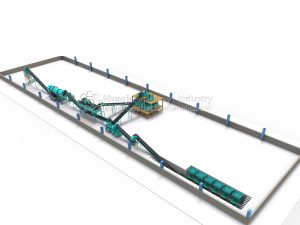
The raw material pre-treatment stage typically includes crushers, batching scales, and mixers. Crushers break down clumps or large pieces of material into the appropriate fineness to ensure smooth granulation; automated batching systems precisely proportion ingredients according to a specific formula; and horizontal or twin-shaft mixers thoroughly blend the materials while adjusting moisture content, ensuring consistent material properties and uniform granule strength. Conveying equipment—such as belt conveyors, bucket elevators, and screw feeders—transports materials throughout the line, while forced-feeding mechanisms ensure a steady supply and prevent blockages or interruptions.
The extrusion unit serves as the core of the production line, with flat-die and double roller press granulators being the most common types. These machines use mechanical pressure to form powdered materials into granules; this process requires minimal binder, is relatively simple, consumes a moderate amount of energy, and is well-suited for dry granulation. Depending on the desired product specifications, a shaping unit can be added to refine the appearance of the granules.
Following the forming stage, the process moves to post-processing. Since newly formed granules are often hot and lack stability, they must pass through a cooler. In cases where moisture content is high, a dryer is also required to reduce moisture, facilitating long-term storage. A vibrating screen then classifies the granules, separating the high-quality product from fine dust and oversized waste. The screened-out fines are returned to the granulation process via a recycling system, maximizing raw material utilization and minimizing waste.
At the end of the line, the finished product is handled by storage and packaging equipment—including storage silos, automatic weighing/packaging scales, and bag-sealing machines—to complete the process of quantitative bagging. Dust collection equipment is installed at various dust-generating points to improve the workshop environment. The entire production line is integrated with an electrical control system that regulates the operating speeds, start-up, and shutdown of individual units, enabling continuous, automated production.
Configurations vary slightly depending on the industry. In fertilizer granulation, the focus is on proportioning, mixing, and the screening of recycled material. Properly matching the equipment is essential to ensuring a stable output of granules with consistent strength and the required appearance, while also reducing operating costs.