

In the fields of organic fertilizer production and livestock manure resource utilization, windrow compost turning machines are the mainstream equipment for small and medium-sized sites. Many practitioners are concerned about their practicality. Generally speaking, this equipment is suitable for the operational needs of most individual farmers and small to medium-sized farms, offering excellent cost-effectiveness. However, it is not universally applicable; choosing the right machine based on the specific working conditions is crucial to maximizing its value.
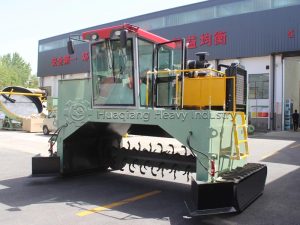
The biggest advantages of windrow compost turners are their flexibility, ease of use, and lower investment. Unlike trough-type compost turners, which require the construction of fixed fermentation troughs and hardened tracks, they do not require complex civil engineering. They can operate on level ground, significantly reducing initial infrastructure costs. The tracked chassis has low ground pressure, excellent maneuverability, and can travel smoothly on soft material storage areas and uneven open-air storage yards. It can also climb small slopes, adapting to irregular sites and mobile fermentation operations, with highly flexible layout adjustments.
It excels in both operational efficiency and operability. The equipment is equipped with a high-powered drive system, providing ample turning force to easily break up clumps of straw and manure, uniformly mix materials, clear air from the pile, accelerate fermentation and maturation, and effectively kill pathogens in the materials. The machine supports hydraulic adjustment of the turning depth to adapt to piles of different heights. It can be operated by a single person, increasing efficiency by dozens of times compared to manual turning, and saving significant labor costs. It is perfectly adequate for daily small- to medium-sized composting operations. Actual test data shows that, for the same material processing capacity, it is more time-efficient and fuel-efficient than traditional wheeled equipment, with lower long-term energy costs.
However, it also has significant drawbacks. A safe distance must be maintained during operation, and there may be some dead corners at the edges of the pile, resulting in slightly less uniform fermentation compared to trough-type equipment. Furthermore, it is unsuitable for processing high-impurity materials containing stones and metal shavings, as it easily wears down the turning teeth and tracks; high-moisture, viscous materials are prone to sticking and clogging, requiring regular cleaning. In addition, the equipment has a complex structure, leading to relatively high maintenance costs after a malfunction.
In summary, the wimdrow compost turning machine‘s suitability outweighs its drawbacks. For small and medium-sized users with limited budgets, flexible sites, and who are processing conventional manure and straw materials, it is a cost-effective and practical piece of equipment; while for large-scale, standardized, and high-impurity material processing scenarios, other models can be selected as appropriate.