

As a core piece of equipment in the production of organic fertilizers and compound fertilizers, the stable operation of disc granulators directly determines product quality and production efficiency. In actual production, the equipment is prone to faults such as poor pelleting, abnormal operating noise, and motor overheating. If not handled promptly, this can lead to raw material waste and downtime losses. Based on practical experience, this article summarizes the causes of various common faults and efficient solutions to help practitioners quickly troubleshoot and accurately handle them.
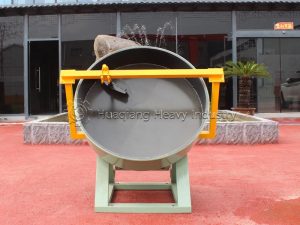
Low pelleting rate and uneven particle size are the most common faults in disc granulators, mostly caused by improper raw material or equipment parameters. When the moisture content of the raw material is unbalanced, if it is too dry, the material will be loose and difficult to agglomerate; if it is too wet, it will easily stick to the wall and clump together. The moisture content needs to be adjusted to 20%-22%. If it is too dry, a binder can be sprayed; if it is too wet, dry material can be added to adjust it. If the raw material lacks viscosity, suitable binders such as bentonite or molasses can be added, or high-viscosity raw materials can be mixed to improve agglomeration. The tilt angle and rotation speed deviation of the equipment also affect pelleting. For organic fertilizer granulation, the tilt angle should be controlled at 18°-22° and the rotation speed at 12-15 r/min. For compound fertilizer, slight adjustments can be made to ensure sufficient material tumbling.
Abnormal operating noises and disc misalignment are often related to component wear or loose fasteners. If the abnormal noise is accompanied by machine body heat, it is often due to insufficient or damaged bearings, requiring timely replenishment of lithium-based grease. If wear is severe, the bearings should be replaced. Gear meshing noises require cleaning impurities and adjusting the meshing clearance. Disc misalignment is often caused by uneven wear of the support wheels or loose bolts; worn wheels need to be replaced and bolts tightened. At the same time, ensure uniform feeding and avoid one-sided force.
Motor overheating and overload shutdowns are mainly caused by excessive load or poor heat dissipation. Excessive feeding or excessively viscous material will increase the motor load; the feed rate should be reduced and the material viscosity adjusted. Dust accumulation on the motor heat sink or fan failure can cause overheating; dust should be cleaned promptly, and the fan replaced. In high-temperature environments, ventilation equipment can be added.
Most malfunctions can be avoided through standardized operation. Regular equipment inspections and maintenance are essential, including periodic lubrication of core components, cleaning of residual materials, and inspection of vulnerable parts. Mastering these solutions will enable you to quickly handle common malfunctions of disc granulators, reduce downtime, extend equipment lifespan, and ensure efficient and stable production line operation.