

The compost turning machine is the core equipment in organic fertilizer fermentation production, accelerating material maturation through turning, stirring, and oxygenation. Currently, the mainstream turning machines on the market are mainly divided into three categories: trough type, windrow type, and disc type. These three types differ significantly in structural design, operational performance, and applicable scenarios, directly affecting the efficiency and cost of organic fertilizer production. Livestock farmers and organic fertilizer manufacturers can choose the appropriate model according to their needs.
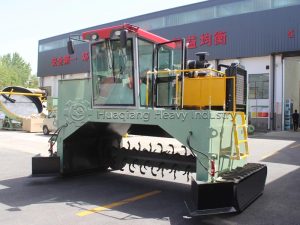
The trough type compost turning machine is the mainstream model for large-scale production. It requires a fixed cement fermentation trough for operation, running at a uniform speed along a track, relying on a rotating cutter shaft to turn, crush, and move the material. This equipment has a stable structure, a high degree of automation, uniform turning, and good fermentation effect. It is suitable for high-moisture, high-viscosity materials such as chicken manure, sludge, and kitchen waste, effectively preventing material clumping and anaerobic odor problems. However, its limitations are obvious: it requires a regular, hardened site, has high initial infrastructure investment, and lacks flexibility, making it only suitable for large and medium-sized organic fertilizer plants for large-scale, standardized production.
Windrow compost turners are flexible and versatile equipment. They do not require a fixed fermentation tank, moving only on tracks, and can adapt to various sites including open areas, greenhouses, and uneven terrain. The equipment is easy to operate and move freely, allowing for flexible adjustment of the working position and turning depth. It is suitable for most common materials such as straw, manure, and mushroom residue, making it highly versatile. However, its turning depth is limited, its single-batch processing capacity is relatively small, and its automation level is relatively low. It is more suitable for small and medium-sized farms, small cooperatives, and scenarios with irregular sites and flexible production scales.
Large wheel compost turners are designed for large-span, deep operations, specifically for large fermentation tanks. Their turning depth and working span far exceed those of ordinary tank-type equipment, offering energy efficiency, high throughput, and large capacity. They are more suitable for loose materials with high fiber content and low viscosity, such as straw and rice husks. However, when processing high-moisture, viscous materials, the materials can easily stick to the equipment, affecting operational efficiency. They are mostly used in large-scale organic fertilizer plants for centralized fermentation of large quantities of materials.
In summary, each of the three types of compost turners has its own advantages and disadvantages. The key to selection lies in matching the production scale, material characteristics, and site conditions to maximize equipment efficiency, reduce production costs, and ensure the quality of organic fertilizer fermentation.