

Answer: The disc granulator primarily utilizes a wet granulation process. It is suitable for various powdery and fine-grained materials with moisture content ranging from 25% to 40%, performing best with raw materials that possess moderate viscosity and a tendency to agglomerate. Key applicable materials include organic fertilizer feedstocks such as livestock and poultry manure, straw powder, peat, humus soil, and fermented sludge, as well as conventional industrial materials like chemical powders, feed powders, and mineral powders; however, it is unsuitable for dry, hard, non-cohesive materials or large, rigid chunks.
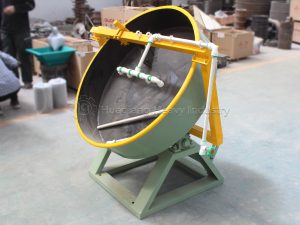
This equipment has a wide range of applications. It is primarily used in the organic fertilizer industry as the core shaping unit in production lines, manufacturing products such as granular organic fertilizer, horticultural nutrient soil pellets, and slow-release flower fertilizers. It is also widely used in fields such as feed processing, chemical building materials, and the pelletizing of mineral powders.
Compared to other granulation equipment, it offers a broad material compatibility range, produces round and uniform granules, is easy to operate, and entails low investment costs, making it highly suitable for small and medium-sized production lines. During production, consistent granulation quality can be ensured simply by making minor adjustments to moisture, rotation speed, and the disc angle based on material characteristics; consequently, it is widely adopted by small and medium-sized enterprises in the industrial, mining, agricultural supply, and feed sectors for granulation operations.