

Oil palms, a large quantity of high-quality agricultural waste, are rich in nutrients such as cellulose, potassium, calcium, and magnesium. Through scientific processing, they can be transformed into high-quality organic fertilizer. This resource-based production process is green, environmentally friendly, and highly efficient, solving the pollution problem caused by accumulated shells while providing a natural fertilizer source for the planting industry, achieving a win-win situation for both ecology and economy. The complete production process mainly consists of three stages: pretreatment, fermentation and maturation, and refining.
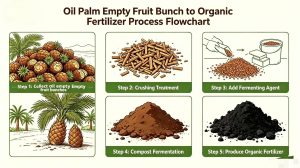
Raw material pretreatment is the fundamental step in production. Fresh oil palm empty fruit bunchs have high water content, are bulky, and have coarse fibers, resulting in extremely slow natural degradation. First, a crusher breaks down large shells into fine fibrous materials of 1 to 3 centimeters, reducing the material volume and increasing the contact area. Then, impurities are removed from the material, and the humidity is adjusted by spraying palm oil processing wastewater, controlling the material’s moisture content to 55% to 65%, creating suitable conditions for microbial reproduction and simultaneously achieving wastewater recycling, reducing production costs.
High-temperature aerobic fermentation and maturation is the core step. The pre-treated materials are piled up and special composting bacteria are added in proportion to accelerate the decomposition of lignin and cellulose. A windrow composting method is adopted, with continuous ventilation and oxygenation management. The pile is turned regularly every three days using a compost turning machine to prevent oxygen deficiency and the generation of odors and harmful substances. The fermentation cycle is approximately 45 days. During this period, the pile can heat up on its own, and the high-temperature environment effectively kills insect eggs, pathogens, and weed seeds. When the material turns dark brown, becomes loose and odorless, and the temperature naturally returns to room temperature, it is considered fully decomposed and transformed into a usable organic substrate.
Finally, it enters the refining and shaping stage. The decomposed organic fertilizer is screened through a screening machine to remove incompletely degraded coarse material, retaining a fine and uniform high-quality fertilizer. Depending on the application requirements, it can be directly made into powdered organic fertilizer or compressed into granular fertilizer for convenient storage, transportation, and mechanized fertilization. The finished organic fertilizer has balanced nutrients, effectively improving soil structure, enhancing soil water and fertilizer retention capacity, replacing some chemical fertilizers, and helping to improve the quality and yield of oil palm and various crops.
The entire production process is simple, efficient, green, and low-carbon, turning waste fruit shells into valuable resources and building a green chain for the recycling of waste in the oil palm industry. It is a high-quality practice of modern agricultural ecological circular development.