

When selecting equipment, many livestock farms and small-scale organic fertilizer plants grapple with a key question: Is the windrow compost turner easy to operate? Unlike traditional trough-style turners—which require complex civil engineering and track calibration—the self-propelled crawler compost turner is designed for “foolproof” operation. It requires no prior experience or specialized technical personnel; ordinary workers can operate it independently after brief training, making it an ideal choice for composting and fermentation at small-to-medium-sized sites.
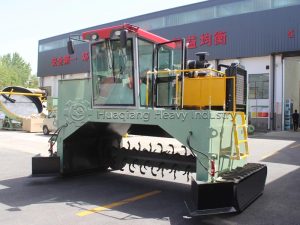
The operating process is streamlined, eliminating cumbersome control steps. The machine features an integrated smart control panel with clear, intuitive buttons for basic functions—such as moving forward/backward, steering, lifting/lowering, and starting/stopping the turning mechanism—all with easy-to-understand labels. No complex setup is required before operation; a quick check of the machine body, blades, and oil levels, along with ensuring the site is free of large, hard debris, is all that is needed to start. The machine utilizes a hydraulic control system, ensuring smooth movement and flexible steering. Its crawler tracks are well-suited for muddy or soft composting sites, preventing slippage or getting stuck, which significantly simplifies operation.
Even novices with no prior experience can quickly master the controls, keeping the learning curve short. Typically, workers can grasp the basics in half an hour and become proficient at independent operation after just one day of hands-on practice. The equipment includes automatic speed adjustment and overload protection; it automatically shuts down if material jams occur, effectively preventing equipment damage and safety accidents. No manual assistance is needed for feeding or pushing material; the machine autonomously handles the entire process—turning, breaking up, aerating, and throwing the material—operating fully automatically to save significant labor and effort.
Beyond ease of use, the equipment is also convenient to maintain. It features a simple structural design with few wear-prone parts; routine maintenance involves only clearing away debris and periodically adding lubricant, avoiding complex servicing procedures. Unlike large stationary turning equipment, it does not rely on fermentation troughs and can be moved freely between work sites. It flexibly adapts to windrow composting methods, meeting the production needs of family farms and small-to-medium-sized livestock operations.
In summary, the windrow compost turner stands out for its ease of use, low barrier to entry, and high adaptability, effectively solving the problems of complex operation and reliance on specialized personnel associated with traditional fermentation equipment. It saves time, effort, and labor, truly enabling low-cost, high-efficiency manure composting and fermentation; it is ideally suited for small- to medium-scale agricultural operations.