

Yes, a disc granulator can be used for chicken manure granulation. It is a common forming device in small- and medium-sized chicken manure organic fertilizer production lines. Favored for its ease of operation and high pelletizing rate, it is widely used in projects that process fermented chicken manure into granular organic fertilizer; Huaqiang Heavy Industry offers one-stop services for organic fertilizer production lines.
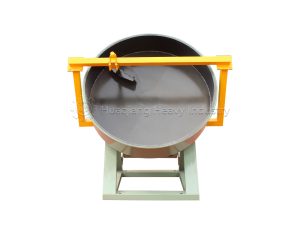
The disc granulator operates by rotating an inclined disc; under the influence of gravity and friction, the material continuously tumbles and agglomerates. Combined with a spraying system for humidification, spherical granules gradually form. The pelletizing rate can exceed 90%, yielding round, uniform granules with adjustable sizes, which facilitates subsequent drying, screening, packaging, and storage/transport. However, it is important to note that fresh chicken manure cannot be fed directly into the granulator; it requires prior treatment. Raw, unfermented chicken manure has high moisture content and unstable viscosity, and contains insect eggs and pathogens; using it directly causes the material to stick to the disc and leads to mold growth in the finished product. The correct process involves composting and maturing the manure, crushing it, and mixing it with additives—such as straw or humus—to adjust the carbon-nitrogen ratio and viscosity. The moisture content must be controlled within the 50%–60% range before the material is fed into the disc granulator.
Using a disc granulator to process chicken manure organic fertilizer offers significant advantages. The equipment requires a moderate investment, features a simple structure, and allows for easy visual monitoring of the granulation process. Operators can flexibly adjust granule size by modifying the disc’s inclination angle, rotation speed, and water spray volume. Additionally, the machine offers convenient maintenance and low energy consumption, making it ideal for small- and medium-sized organic fertilizer plants and manure resource utilization projects at livestock farms.
However, there are also limitations. Disc granulation is a wet granulation process; the resulting wet granules require subsequent drying and cooling stages. Without these, the granules lack sufficient strength and are prone to breakage. Compared to large-scale rotary drum granulators, disc granulators have a more limited single-unit production capacity, making them better suited for small- to medium-scale operations. Inadequate raw material pretreatment can lead to issues such as material sticking to the disc, unstable granule formation, and excessive fines; therefore, strict control over raw material fineness and moisture content is essential.
Overall, the disc granulator is ideally suited for granulating chicken manure-based organic fertilizer, offering a highly cost-effective solution for small- and medium-sized manure resource utilization projects. With proper execution of preliminary steps—such as fermentation, crushing, and moisture adjustment—producers can consistently manufacture high-quality organic granular fertilizer from chicken manure, thereby transforming waste into a valuable resource. Enterprises planning to expand production can evaluate both disc and rotary drum granulation options based on their capacity requirements to establish a comprehensive organic fertilizer production line.