

The cage crusher—also known as a cage mill—is a piece of small-to-medium-sized fine-crushing equipment designed based on the principle of impact crushing. Featuring a unique structure where dual cages rotate against each other, it serves as a core machine for the fine crushing and de-agglomeration of materials in industrial production. It is widely used for processing various brittle materials of low to medium hardness across industries such as construction materials, chemicals, agricultural supplies, and mining.
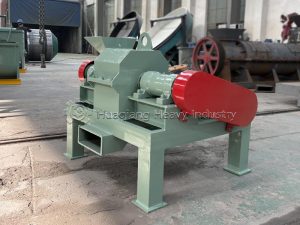
The cage crusher boasts a simple yet ingenious design. Its core components consist of two nested cage-like rotors—an inner and an outer one—with high-strength, wear-resistant steel bars evenly arranged along the cage bodies. Complemented by a dual-motor drive system, feed and discharge ports, and a sealed housing, the overall structure is compact and stable. Unlike conventional hammer or chain mills, its standout feature is the ability of the dual cage bodies to rotate at high speeds in opposite directions; this structural design is the key to its high crushing efficiency.
Its working principle is straightforward: it achieves fine crushing through high-speed counter-rotating impacts. Material enters the center of the inner cage from the top inlet and spins rapidly with it; centrifugal force flings the material against the steel bars, causing violent impacts that result in initial breakage. Subsequently, the material passes between the counter-rotating inner and outer cages, undergoing continuous, repeated impact, shearing, and friction, which progressively reduces its particle size. Material that meets the required size specifications is quickly discharged through the gaps between the cage bars, while coarser particles continue to circulate and be crushed within the cages until they meet the discharge standards. The entire process ensures uniform crushing without leaving residual agglomerates.
Compared to traditional crushing equipment, the cage crusher offers significant advantages. First, it delivers high crushing efficiency and uniform output fineness, combining crushing with material mixing and de-agglomeration capabilities, making it effective for handling agglomerated materials. Second, the equipment features excellent sealing, resulting in minimal dust generation and stable operation, as well as lower noise levels and energy consumption. Third, its simple, durable, and wear-resistant structure facilitates easy cleaning and maintenance, ensures a low failure rate, and makes it suitable for long-term, continuous operation. Moreover, it boasts exceptional adaptability, capable of processing various brittle materials—such as chemical fertilizers, gypsum, coal, and ores—with moisture contents below 6%.
Today, thanks to its stable and reliable performance, the cage crusher has become the equipment of choice for applications ranging from compound fertilizer production and building material processing to the pretreatment of chemical raw materials and the fine crushing of small-scale ores. As a fundamental tool for precision pulverization, it offers an efficient solution for the pretreatment of diverse industrial materials, characterized by high efficiency, energy conservation, and ease of maintenance; it serves as an indispensable core component in modern light and heavy industrial production lines.