

In organic and compound fertilizer production lines, the fine crushing of raw materials is a critical step that determines the quality of subsequent ingredient mixing, granulation rates, and the final product. Thanks to its unique structural advantages, the cage crusher has become the mainstream equipment for the fine crushing stage in the fertilizer industry. Huaqiang Heavy Industry leverages its one-stop service capabilities to supply this equipment to numerous fertilizer plants, effectively resolving various pain points in the production process.
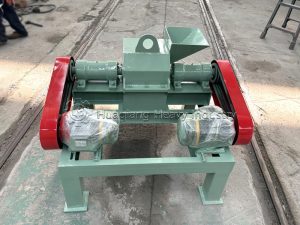
The cage crusher operates on the principle of high-speed, counter-rotating collisions between inner and outer cage bars; materials are crushed as they move from the inside out, undergoing repeated impacts across multiple layers. Its primary distinction from traditional hammer mills is the screenless design; it relies on centrifugal force and the gaps between cage bars to classify and discharge material, fundamentally eliminating the problem of machine clogging caused by wet materials. Fertilizer raw materials are complex—fermented livestock manure and humic acid contain moisture, while straight fertilizers like urea, monoammonium phosphate (MAP), and potassium chloride are prone to clumping due to humidity. Standard crushers often suffer from screen blinding and require shutdowns for cleaning when handling moist materials, whereas the cage crusher stably processes high-moisture materials without requiring pre-drying. This simplifies upstream processing and ensures continuous production.
Uniform output particle size is another major advantage of the cage crusher. After undergoing multi-stage impact crushing, the material achieves a consistent particle size distribution that can be flexibly adjusted to meet granulation requirements; the process yields minimal oversized particles or excessively fine powder, resulting in good material looseness. Uniformly crushed material improves mixing homogeneity, significantly boosting granulation rates for disc, rotary drum, and roller extrusion granulation processes. This reduces the volume of recycled material (fines/oversize), stabilizes the appearance and nutrient balance of the finished fertilizer, and lowers the defect rate.
The equipment features a simple structure, stable operation, and low maintenance costs. The entire unit undergoes dynamic balancing to minimize vibration, offers excellent sealing performance, and generates minimal dust during production. The primary wear parts are the wear-resistant cage bars, crafted from high-chromium alloy for extended service life; they are easy to install and replace, require minimal daily maintenance, and reduce production line downtime for servicing. The machine features a compact footprint, integrates seamlessly into organic fertilizer production lines, and is suitable for facilities ranging from small-scale blending stations to large-scale fertilizer plants.
In summary, the cage crusher handles both dry and wet raw materials effectively, resists clogging, ensures uniform output, and offers easy operation and maintenance. Capable of meeting the crushing requirements for various organic and compound fertilizer materials while balancing production efficiency and product quality, it is an ideal choice for the fine-crushing stage of fertilizer production lines. Huaqiang Heavy Industry provides one-stop services, offering customized solutions tailored to specific capacity requirements to help fertilizer enterprises achieve stable and efficient production.