

During the selection phase of a fertilizer granulation project, many clients find themselves weighing different granulation technologies. With its ability to produce well-rounded granules, intuitive adjustment processes, and moderate investment requirements, the disc granulation production line has become a preferred choice for small to medium-sized fertilizer projects. However, it is not suitable for every operational scenario; it delivers maximum efficiency only when the raw materials, production capacity, and product positioning are well-aligned. Drawing on years of project experience, Huaqiang Heavy Industry has outlined the ideal use cases for this technology.
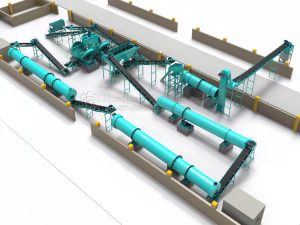
In terms of raw materials, disc granulation—a form of wet agglomeration—is well-suited for finely powdered materials that have undergone thorough fermentation and decomposition. Fermented animal manures (such as chicken, cattle, or pig manure) can be combined with organic additives—including straw powder, fungal residue, pharmaceutical waste, sugar refinery by-products, or biogas sludge—to produce organic fertilizers, bio-organic fertilizers, and organic-inorganic compound fertilizers. It is also compatible with various powdered NPK (nitrogen, phosphorus, and potassium) raw materials for the production of low-to-medium concentration compound fertilizers. Provided the raw materials meet specific fineness requirements and an appropriate binder is added, the process achieves excellent granulation. It is essential to maintain an optimal moisture content: if the material is too dry, it will not form granules effectively, while excessive moisture can cause the material to stick to the granulation disc. Consequently, this method is not suitable for materials with high stickiness or those containing large, hard, solid chunks.
Regarding production scale, disc granulation lines are best suited for small to medium-sized enterprises or fertilizer processing plants integrated with livestock farms, typically handling annual outputs of up to several tens of thousands of tons. The production line features a simple structure; by incorporating auxiliary equipment—such as crushers, screens, dryers, coating machines, and packaging systems—the plant can be brought into operation quickly. The equipment has a small footprint and requires minimal investment in infrastructure. Operation is intuitive: the granulation process on the disc is clearly visible, and parameters such as rotation speed and disc inclination can be adjusted in real-time. This makes the system easy for operators to master and ensures low long-term maintenance costs. Compared to other granulation technologies, disc granulation offers an excellent price-to-performance ratio, making it an ideal solution for projects with limited initial capital or restricted site space.
From the perspective of product requirements, if a client prioritizes the visual appearance of the fertilizer—specifically seeking well-rounded, spherical granules with uniform particle size—a disc granulation production line should be the top consideration. The resulting granules feature excellent flowability and are resistant to caking, making them easy to bag, store, transport, and apply using mechanized field-spreading equipment. Their appearance is also highly favored by both distributors and growers. The production line offers flexible granule-size adjustment, capable of producing 2–5 mm fertilizer granules to meet the specific fertilization requirements of fruit orchards, field crops, and various cash crops.
However, it is also important to recognize the limitations of this technology. Disc granulation is generally less suitable for ultra-high-capacity projects; it is sensitive to the moisture content and fineness of the raw materials, and the energy consumption during the drying stage is significant. If your raw materials consist of decomposed organic powder, your project is on a small-to-medium scale, you require high-quality, spherical granules, and you are working with limited budget or space, then a disc granulation production line is an ideal choice. Enterprises should consult with equipment manufacturers to develop a customized, comprehensive process flow based on raw material analysis, ensuring stable and consistent production.