

The double roller press granulator is the core piece of equipment for dry-process, ambient-temperature granulation. It relies on physical compression to form granules, requiring no binders or drying stages. It is a common machine in compound fertilizer production lines; the model offered by Huaqiang Heavy Industry is widely used for granulating powdered fertilizer materials due to its stable forming process.
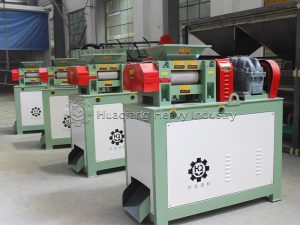
The first step in the granulation process is raw material pretreatment. The powdered materials are proportioned, mixed, and pulverized to meet specific fineness requirements, with moisture content carefully controlled—too much moisture can cause the material to stick to the rollers, while too little can result in insufficient granule strength. The prepared powder is fed into a hopper and pushed by a screw-type forced-feeding mechanism, ensuring a uniform and continuous flow into the gap between two counter-rotating, synchronized pressure rollers. During this stage, air is removed from the powder to prevent trapped air from causing loose, fragile granules.
The core forming process takes place between a pair of pressure rollers, the surfaces of which feature recessed molds. As the rollers rotate in opposite directions at a constant speed, the powder is drawn into the nip (the gap between the rollers). As the gap narrows, the compression force increases, forcing the powder particles tightly together, eliminating internal voids, and causing the material to undergo plastic deformation. The material is pressed into the molds on the roller surfaces, forming continuous strips or sheets of compacted material. These molds can be customized to control the size and shape of the final granules—most commonly producing flattened, spherical shapes.
As the rollers continue to rotate, the molds move out of the high-pressure zone. The pressure on the material is released, and the material—aided by its own elasticity—detaches from the roller surface and falls into a crushing and sizing unit below. Here, a toothed crushing roller breaks apart the compacted strips or sheets, separating them into individual granules. The material then passes through a rotary screen (trommel screen) for classification. Granules that meet the size specifications are discharged as finished products, while fine powder and fragments are returned via a conveyor system to the feed end. There, they are mixed with fresh raw material and re-processed into granules. This creates a closed-loop production system, significantly improving raw material utilization and minimizing waste.
The entire process operates at ambient temperature without any drying stage, resulting in lower energy consumption and ensuring that the effective nutrients within the fertilizer remain intact. Compared to disc or rotary drum wet granulation, the roller extrusion granulation process is simpler, offers faster granulation, and produces dense, durable granules that resist crumbling—making them easy to store, transport, and apply via mechanical spreaders. This method is compatible with a wide range of raw materials, such as potassium chloride, ammonium sulfate, and organic powders; it allows for flexible formula adjustments, offering significant advantages for small and medium-sized fertilizer plants. By effectively controlling raw material moisture content, feed rate, and roller pressure, producers can consistently manufacture uniform, high-quality granular fertilizer while ensuring the long-term, stable operation of the production line.