

Aerobic fermentation is the core process for maturing organic fertilizer, relying on aerobic microorganisms to decompose organic materials such as livestock manure, crop straw, and sludge. The windrow compost turning machine is a critical piece of equipment for regulating the fermentation environment in windrow composting. By continuously turning, aerating, and mixing the materials, the Huaqiang Heavy Industry windrow compost turning machine creates a stable and suitable environment for microorganisms, promoting the orderly maturation of the compost. It serves as the central component of the fermentation stage within an entire organic fertilizer production line.
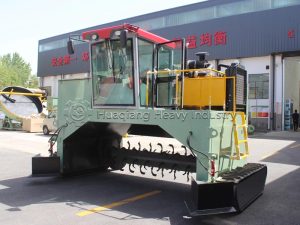
Before operation, raw materials are mixed with microbial inoculants according to a specific ratio and arranged into long, narrow windrows. The crawler undercarriage provides a large ground-contact area, preventing the machine from getting stuck in muddy or soft terrain as it moves slowly over the windrows. A rotating drum equipped with tines at the bottom lifts, breaks up, and throws the oxygen-deprived material from the bottom of the pile toward the rear, effectively swapping the positions of the upper and lower layers. This action breaks up compacted material, allowing large volumes of air to penetrate the pile. This directly replenishes the oxygen required by aerobic microorganisms, prevents the formation of an anaerobic environment within the pile, and reduces the production of foul odors such as hydrogen sulfide.
The turning process also helps regulate temperature and moisture levels while ensuring material homogeneity. During the heating phase of composting, microorganisms multiply rapidly and release heat, raising the pile temperature to 55–70°C. Periodic turning releases accumulated heat and water vapor, preventing excessively high temperatures from damaging beneficial microbial strains, while simultaneously evaporating excess moisture to maintain an optimal humidity range. Sustained high temperatures over several days effectively eliminate insect eggs, pathogens, and weed seeds, ensuring the material is rendered harmless. For materials where microbial inoculants were initially unevenly distributed or moisture levels varied significantly, the drum’s mixing and crushing action ensures that the microbial strains, bulking agents, and manure are thoroughly blended. This results in uniform fermentation across the entire windrow, preventing issues such as localized raw (undecomposed) material or “burnt” (overheated) spots.
The entire fermentation process is dynamically managed through the frequency of turning. During the initial heating phase, frequent turning is required to ensure sufficient oxygen supply and rapid temperature rise. In the high-temperature sanitization phase, periodic turning helps maintain stable conditions. As the process nears completion, easily decomposable organic matter is exhausted and the pile temperature begins to drop; the frequency of turning is then gradually reduced as the material enters the maturation and stabilization stage.
Compared to manual turning or the use of front-end loaders, a windrow compost turning machine offers greater turning depth and more uniform oxygen distribution. The windrow-based process eliminates the need for dedicated fermentation bays, resulting in lower infrastructure investment—making it an ideal solution for small-to-medium-scale organic fertilizer plants and manure-to-resource projects at livestock farms. The combined effects of continuous oxygen supply, thorough mixing, and heat dissipation facilitate stable metabolic activity in aerobic microorganisms. This process gradually transforms organic waste into a loose, stable, and odorless mature organic fertilizer, effectively realizing the recycling and resource utilization of waste materials.