

The disc granulator is a core forming device in the production of organic and compound fertilizers. Thanks to its simple structure, high pelletizing rate, ability to produce round granules, and flexible adjustability, it is widely used to granulate materials such as livestock manure, crop straw residues, and powdered fertilizers. Issues such as uneven granule size, fragility, and material sticking to the disc—often encountered in production lines—usually stem from a lack of understanding regarding the machine’s working principle and parameter optimization.
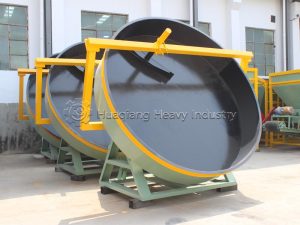
The disc granulator primarily consists of an inclined granulating disc, a variable-frequency drive mechanism, an automatic scraper, a spray-based humidification system, and a disc-tilt adjustment device. The equipment operates on the principle of wet rolling agglomeration; dry powder materials do not require high-pressure extrusion but instead form spherical granules through rolling, bonding, and layer-by-layer growth. The resulting granules are dense and well-formed, making them easier to dry, screen, package, and store.
The forming process comprises three key stages. The first is the core formation stage: fermented and pulverized powder enters the inclined disc, is carried upward by the disc’s rotation, and then rolls down naturally under gravity. The spray system adds water evenly, creating surface tackiness on the powder; fine particles adhere to one another to form numerous tiny nuclei, laying the foundation for subsequent growth.
The second stage is granule growth: as the nuclei continuously roll, collide, and rub against each other, they adsorb surrounding dry powder and moisture. Like a rolling snowball, they thicken layer by layer and grow uniformly. Stable feed rates, water spray volumes, and rotation speeds are critical at this stage; insufficient water leads to loose, fragile granules, while excessive water causes sticking to the disc and clumping.
The final stage is polishing, classification, and discharge: mature granules are repeatedly polished against the disc surface, resulting in a smooth, round finish and a dense internal structure. Influenced by the disc’s tilt angle and centrifugal force, granules that reach the target size automatically spill over the edge for discharge, while smaller granules remain in the disc to continue growing. This enables continuous, automatic classification and granulation, effectively ensuring uniform granule size.
In production, four key parameters—disc tilt angle, rotation speed, water spray volume, and feed rate—directly determine the granulation results. In organic fertilizer production, an inclination angle of 45°–50° is commonly employed; when paired with the appropriate rotational speed, this balances granule formation time with equipment throughput. With properly optimized parameters, the equipment achieves a pelletization rate exceeding 80%, fully meeting the mass production requirements of small- and medium-sized organic fertilizer lines, making it a highly efficient pelletizing solution for the resource utilization of manure and waste.