

With tightening environmental policies for livestock and poultry farming and the promotion of green agriculture, the harmless and resource-based treatment of manure has become a necessity for farms and organic fertilizer plants. As the core equipment for composting fermentation, the organic fertilizer compost turner is gradually replacing traditional manual turning methods. With its high efficiency, energy saving, and ease of use, it has become an essential piece of equipment for organic fertilizer production, effectively solving the industry problems of slow fermentation, strong odor, and high costs associated with traditional composting.
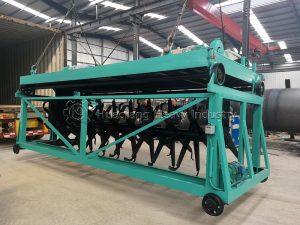
Highly efficient composting and a shortened production cycle are the core advantages of the compost turner. Traditional manual turning results in uneven depths, insufficient oxygen supply, and uneven fermentation of materials, easily leading to undercooked or insufficiently matured materials, with a complete fermentation cycle of two to three months. In contrast, the organic fertilizer turner, through integrated mechanical deep tillage, mixing, and spreading, can quickly break up materials, fully contact them with air, effectively increase the oxygen content of the compost pile, accelerate high-temperature fermentation, and quickly kill insect eggs, pathogens, and weed seeds, shortening the fermentation cycle to 15 to 25 days and significantly improving production efficiency.
The equipment significantly saves labor costs and reduces production input. Traditional composting requires a large amount of manpower for repeated turning, leveling, and stacking of materials, resulting in high labor intensity and labor costs. Modern organic fertilizer compost turners are highly automated, allowing a single person to operate the entire machine without extensive manual assistance, completely eliminating reliance on manual labor. Long-term operation can save significant labor costs, and they are suitable for various sizes of livestock farms and organic fertilizer production scenarios.
Simultaneously, compost turners enable environmentally compliant production and improve the working environment. The turning process quickly evaporates moisture and harmful gases from the compost pile, reducing the accumulation of ammonia and hydrogen sulfide, effectively reducing odor pollution in livestock farms and avoiding environmental problems caused by manure accumulation. Combined with standardized fermentation sites, zero emissions of manure and resource reuse can be achieved, meeting environmental inspection standards.
Furthermore, the equipment is highly adaptable, with various models including tracked, trough, and wheeled types, suitable for various raw materials such as chicken manure, cow manure, straw, and sludge, offering flexible site adaptation. The equipment is robust, wear-resistant, durable, has a low failure rate, is easy to maintain, and has a cost-effectiveness far exceeding that of traditional manual methods. It is a core supporting equipment for the resource utilization of agricultural manure and the large-scale production of organic fertilizer.