

Aerobic fermentation is the core stage of organic fertilizer production, and the performance of the turning equipment directly determines fermentation efficiency, fertilizer quality, and production costs. Among the various types of turning equipment, the windrow compost turner has become the preferred choice for small-to-medium organic fertilizer plants and livestock manure fermentation facilities, thanks to its key advantages: broad adaptability, high operational efficiency, and controllable costs.
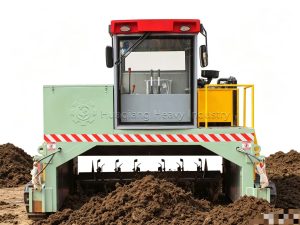
Strong site adaptability is a primary advantage. Traditional trough-type compost turners require the construction of dedicated fermentation troughs and hardened ground surfaces, resulting in high initial infrastructure costs and a lack of flexibility regarding site layout. In contrast, windrow compost turners utilize a tracked chassis with a large ground contact area and low ground pressure; they operate effectively on muddy, soft, or uneven outdoor terrain and possess strong climbing capabilities. They require no fixed infrastructure, allow for the free shifting of work areas, and suit diverse scenarios—such as open-air composting and decentralized fermentation—thereby significantly lowering the barrier to entry for setting up a facility.
Secondly, the equipment ensures uniform fermentation and enhances fertilizer quality. Adequate oxygen supply and thorough decomposition are critical to organic fertilizer fermentation. Equipped with high-speed rotating crushing blades, the machine performs turning and crushing simultaneously; it turns materials deeply to eliminate “dead zones” in the fermentation pile, ensuring that raw materials—such as livestock manure, straw, and sludge—make full contact with oxygen. This facilitates rapid moisture evaporation and the discharge of harmful gases, effectively preventing issues like localized anaerobic mold growth or uneven decomposition. Consequently, the fermentation cycle is drastically shortened, resulting in organic fertilizer with consistent nutrient content and stable quality.
Furthermore, the equipment offers superior cost-effectiveness and ease of operation and maintenance. Compared to large-scale fixed equipment, windrow compost turners require lower initial investment, making them ideal for small-to-medium production needs. They feature intelligent control systems with one-touch startup and stepless speed regulation, ensuring simple, user-friendly operation and minimal labor costs. Additionally, their robust structure ensures a low failure rate and simple maintenance, resulting in low long-term operating costs and suitability for the vast majority of organic fertilizer production scenarios.
In summary, for standard organic fertilizer fermentation, the windrow compost turner balances flexibility, efficiency, and cost-effectiveness. Suitable for the overwhelming majority of production scenarios, it is undeniably the preferred choice for organic fertilizer fermentation processes.