

Organic fertilizer compost turning is the core process in the resource-based fermentation of manure. The choice of turner directly determines the fermentation effect, production efficiency, and input costs. Currently, the mainstream models on the market are windrow, trough, and wheel-type, making it difficult for many livestock enterprises and organic fertilizer processing plants to choose. Don’t blindly follow trends; match the model to your site conditions, production scale, and raw material type to achieve a balance between cost-effectiveness and practicality.
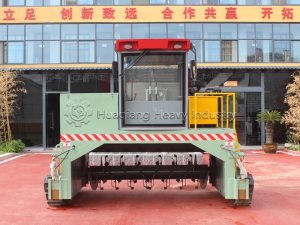
Trough-type compost turners are standard equipment in large-scale organic fertilizer plants. The equipment runs along a fixed track, achieving a deep turning depth and uniform mixing. It is suitable for high-moisture, high-viscosity materials such as chicken manure, pig manure, and sludge, with stable fermentation and maturation effects. It can be used in a closed fermentation workshop for centralized deodorization and environmental compliance, making it suitable for long-term continuous production. The disadvantages are the need to pour fermentation tanks and tracks, high infrastructure investment, fixed site, and poor flexibility. It is more suitable for standardized organic fertilizer plants with an annual output of over 10,000 tons and not for scattered open-air operations.
Windrow compost turners are characterized by their flexibility and convenience, making them the preferred choice for small and medium-sized livestock farmers. Utilizing a tracked chassis, they can adapt to muddy and uneven open-air sites, eliminating the need for earthen fermentation tanks and allowing for immediate operation, significantly reducing initial investment. The equipment is freely movable, capable of multi-stacking, and suitable for materials such as cow manure, straw mixtures, and garden waste, making it ideal for on-site manure treatment in small and medium-sized farms. However, its drawbacks include susceptibility to weather conditions during open-air operation, the tendency for highly viscous materials to stick to the equipment, increased wear and tear, and relatively high long-term maintenance costs.
Large wheel compost turners, on the other hand, emphasize large span, high efficiency, and low energy consumption, and are specifically designed for large, standardized fermentation tanks. The extra-large discs provide wide coverage and high stack height with a single turn, resulting in fast operation, low labor costs, excellent crushing and turning effects, less dust, and better environmental performance. However, this equipment has stringent requirements for materials and is better suited for low-moisture, loose raw materials such as straw and sawdust. Fresh, high-moisture livestock and poultry manure is prone to causing blockages and entanglement. Furthermore, the equipment is expensive and requires high precision in infrastructure, making it suitable only for large-scale organic fertilizer production lines.
In summary, for fixed plant areas and large-volume processing of high-moisture manure, trough-type equipment is recommended; for small to medium-sized open-air operations with limited space,windrow-type equipment is recommended; and for large plants and mass production of loose materials, wheel-type equipment is recommended. Selecting the appropriate model based on specific needs maximizes the equipment’s value.