

Fertilizer is the “food” of agricultural production, and fertilizer production lines are the core carriers for ensuring a stable supply and improving fertilizer quality. With the development of modern agriculture, fertilizer production lines have evolved into various types based on different raw materials, processes, and uses, adapting to different production needs and providing diverse support for green agriculture and large-scale planting.
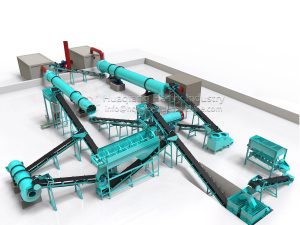
Organic fertilizer production lines are the mainstream choice for green agriculture, focusing on the resource utilization of waste. They use organic waste such as livestock and poultry manure, crop straw, and kitchen waste as raw materials. The core processes include fermentation, composting, crushing, mixing, granulation, drying, cooling, and packaging. High-temperature fermentation kills harmful bacteria and insect eggs, turning waste into treasure. These production lines are available in various scale configurations, ranging from large-scale equipment suitable for large factories to small-scale combinations suitable for family farms and cooperatives, contributing to the development of a circular economy in agriculture.
NPK compound fertilizer production lines focus on nutrient balance, precisely adjusting the proportions of nitrogen, phosphorus, potassium, and trace elements according to the needs of different crops and soils. The core processes are divided into two types: drum granulation and extrusion granulation. Drum granulation offers high capacity and wide adaptability, making it suitable for large-scale commercial production; extrusion granulation eliminates the drying step, resulting in lower energy consumption and making it more suitable for small and medium-sized enterprises. Standardized processes ensure uniform nutrient distribution in fertilizers, effectively increasing crop yields.
In addition, two types of specialized production lines are widely used. BB fertilizer production lines (blended fertilizer production lines) emphasize flexible formulation, using single nitrogen, phosphorus, and potassium fertilizers as raw materials. Through precise metering and mixing, they eliminate the need for granulation, resulting in a simple process with low energy consumption. Formulas can be adjusted on-site according to soil fertility and crop needs, adapting to the personalized planting requirements of different plots. Bio-fertilizer production lines focus on controlling the cultivation and activation of microbial strains, preserving strain activity through specialized fermentation equipment to aid in soil improvement.
While different types of fertilizer production lines have different processes, they are all upgrading towards intelligence and environmental protection. They are adapted to different production scales and agricultural scenarios, collectively forming a modern fertilizer production system, injecting momentum into high-quality agricultural development and promoting the transformation of agriculture towards resource conservation and environmental friendliness.