

Windrow compost turners are core equipment for organic fertilizer fermentation and solid waste resource utilization. They differ from traditional trough-type compost turners due to their advantages of mobility, strong terrain adaptability, and no need for fixed infrastructure. Choosing the right time to use them can improve fermentation efficiency, reduce operating costs, and extend equipment lifespan, making them suitable for various small and medium-sized organic fertilizer production and waste treatment scenarios.
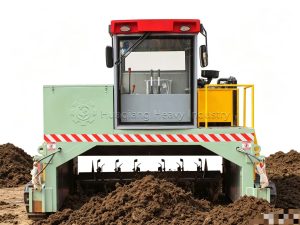
Windrow compost turners are most suitable for complex site operations. Compared to wheeled equipment, which is prone to slipping and getting stuck, tracked chassis have a large ground contact area and strong traction, allowing stable operation on muddy or soft ground, open storage yards, and simple open spaces. They can also handle slopes of around 30°, making them suitable for special sites such as mountain farms, low-lying composting areas in orchards, and ecological restoration in mining areas. Furthermore, this equipment does not require the construction of fixed fermentation tanks or hardened ground, making it suitable for irregular sites and temporary operations, significantly saving on infrastructure investment.
Windrow compost turners are preferred for processing various lightweight organic materials. It is highly adaptable, easily turning over loose organic materials such as chicken and duck manure, pig and cow manure, straw, distiller’s grains, medicinal residue, and biogas residue. It achieves high uniformity in turning, effectively loosening the materials, providing ventilation and oxygen, quickly dissipating heat and odor from the compost pile, and accelerating composting and fermentation. Furthermore, the equipment has built-in corrosion resistance, making it suitable for processing easily corrosive materials such as kitchen waste and municipal sludge, achieving harmless treatment of solid waste. However, it should be avoided with hard materials containing large amounts of stones and metal shavings to prevent wear and tear on the equipment.
Small to medium-sized, seasonal production scenarios are the core application areas for windrow compost turners. For small to medium-sized farms, family farms, and small organic fertilizer workshops with a daily processing capacity of 20 to 100 tons, its operating efficiency is moderate, operation is simple, requires no complex manual labor, and offers excellent cost-effectiveness. For seasonal composting needs such as crop straw recycling and peak livestock and poultry sales seasons, the equipment can be deployed and flexibly moved at any time, with low idle rates, adapting to intermittent and decentralized production modes.
In summary, windrow compost turners are best suited for scenarios with complex terrain, flexible site conditions, processing of lightweight organic materials, and small- to medium-sized seasonal production. Precise matching of usage to specific scenarios maximizes the equipment’s value and contributes to green and resource-efficient production.