

In organic fertilizer production, the half-wet material crusher is the core equipment for solving the problem of crushing high-moisture materials. It is specifically designed to process materials such as livestock and poultry manure, municipal sludge, and fermented compost with a moisture content of 40%-80%. Its core operation revolves around a combined principle of “shearing + extrusion,” achieving efficient crushing and shaping of materials through multi-stage coordinated operation, laying the foundation for subsequent fermentation and granulation processes.
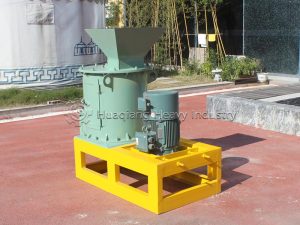
After the equipment starts, it first enters the feeding and pre-compression stage. The screw feeder forcibly conveys the lumpy semi-wet material into the crushing chamber, avoiding the “bridging” phenomenon that occurs with manual feeding. Its blades have an anti-stick coating suitable for high-moisture materials. The pre-compression structure at the front of the chamber applies a compressive force of 1.2-1.5 MPa, compacting loose lumps and removing some interstitial water to reduce viscosity, preparing for subsequent crushing.
The core crushing stage employs a shear-tearing mode. Inside the crushing chamber, the motor drives the main and auxiliary crushing shafts to rotate at high speed via a planetary gear transmission mechanism. The moving blades on the shafts and the fixed blades fixed to the chamber wall form a dense shearing surface. The moving blades rotate at 300-500 rpm, and the stepped arrangement of the blades achieves progressive material refinement. The sharp-angled cutting edges cut into the material, creating tearing points, effectively solving the problem of the high toughness and easy entanglement of semi-wet materials. This stage can crush the material to 10-20mm.
Finally, there is a secondary extrusion shaping and discharge stage. The crushed material enters the screen area. The adjustable gap between the extrusion plate and the screen controls the discharge particle size. Under the action of centrifugal force and extrusion force, qualified material is forced through the screen and discharged, achieving a particle size uniformity of over 90%. Simultaneously, some free water is removed, reducing energy consumption in subsequent processing. The screen is equipped with a high-frequency vibration self-cleaning function, significantly improving the throughput and preventing wet material blockage.
Furthermore, the equipment’s anti-sticking design plays a crucial role. The streamlined inner wall, coated with Teflon, significantly reduces material adhesion. Combined with automatic high-pressure airflow purging, manual disassembly and cleaning are unnecessary. Wear-resistant alloy blades extend service life, ensuring long-term stable operation. This multi-stage collaborative design allows the half-wet material crusher to efficiently solve the pain points of traditional equipment, such as wall adhesion, clumping, and low efficiency, making it a key piece of equipment for the resource utilization of organic fertilizer.