

The flat-die pellet machine is a widely used forming machine, commonly employed in the processing of organic fertilizers, animal feed, and biomass pellets. It relies on the principle of mechanical extrusion to transform loose, powdery, or finely crushed materials into uniform, dense pellets. Featuring a simple structure and stable operation, the equipment eliminates the need for high-temperature drying—thereby maximizing the retention of the material’s active ingredients—and serves as the core component of small-to-medium-scale pellet production lines.
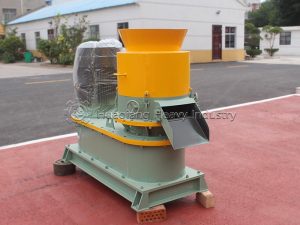
The operation of a flat-die pellet machine involves four sequential steps, running in an automated, continuous cycle. The first stage is uniform feeding: materials that have undergone pre-treatment—such as crushing, mixing, and moisture adjustment—are delivered at a constant speed into the granulation chamber via a screw feeder. A variable-frequency drive (VFD) controls the feeding mechanism, allowing for precise regulation of the feed rate; this prevents material accumulation or under-feeding, ensures consistent granulation, and lays the groundwork for the forming process.
Next comes the core extrusion and forming stage, which is the critical phase of granulation. The machine’s primary components are a stationary flat die and rotating pressure rollers; the die surface features uniformly distributed forming holes of consistent specifications. A motor drives the rollers to roll steadily across the die surface, generating immense extrusion force. This force compacts and densifies the material spread across the die, subsequently driving it into the forming holes. Under high pressure within the holes, the gaps between particles are drastically reduced, transforming the loose powder into solid, compact cylindrical strands.
This is followed by the cutting and discharge stage. A high-speed cutter positioned close to the underside of the flat die rotates at a constant speed, precisely cutting the cylindrical material emerging from the holes into solid pellets of uniform size and shape. The resulting pellets are dense and durable, fully meeting the requirements for storage, transportation, and end-use.
Finally, there is a recycling and optimization stage. Small amounts of fine powder or unformed material generated during the process are automatically returned to the feed inlet to re-enter the granulation cycle. This effectively minimizes raw material waste and maintains a consistently high pelletization rate. Overall, the flat-die pellet machine offers a streamlined, efficient process; it operates at ambient temperatures with low energy consumption, accommodates a wide range of materials, and is highly practical.