

The flat die pellet machine is a widely used forming and processing machine, frequently employed in the production of animal feed, biomass pellets, and organic fertilizers. Valued for its simple structure, ease of operation, and excellent forming results, it serves as the core equipment for small- and medium-sized production lines. It operates on the principle of physical extrusion to granulate materials—requiring minimal additives throughout the process—making it energy-efficient, eco-friendly, and highly practical.
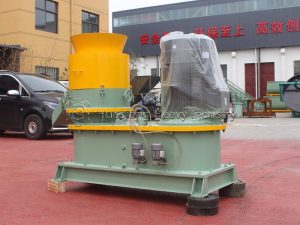
The core working principle of the flat die pellet machine is extrusion molding. The equipment primarily consists of a flat die plate, pressure rollers, a feeding mechanism, a cutter, and a power system. During operation, the motor drives the pressure rollers via a gearbox; the rollers roll at a constant speed across the flat surface of the die plate, forcefully compressing the material spread upon it. This action forces the material through custom-sized die holes to form uniform cylindrical pellets, which are then cut to a standard length by the cutter, completing the granulation process. The die hole size is adjustable between 2.5 and 8 millimeters to meet the production requirements of various materials.
The complete granulation process comprises four key steps. First is material pretreatment: raw materials—such as crop stalks, livestock manure, or feed powders—are crushed and mixed, and their moisture content is adjusted to an optimal range. This ensures the material has the right consistency—neither too dry (which hinders forming) nor too wet (which causes sticking). Next is feeding and spreading: after the equipment is started and preheated, the feeding mechanism delivers material evenly into the granulation chamber, spreading it across the flat die plate to ensure a steady, uniform feed.
Then comes extrusion molding: the pressure rollers roll over the material at a constant speed, using mechanical pressure to compact and force it into the die holes. Inside the holes, friction shapes the material, resulting in a dense, stable structure. Finally, pellet cutting and discharge occur: the extruded cylindrical material moves with the machine’s rotation and is precisely cut by high-speed blades into uniform pellets. These are then ejected from the machine via centrifugal force and become finished products after cooling and air-drying.
Operating a flat-die pellet machine requires attention to key details: regularly checking the fit between the die and the pressure rollers, promptly clearing any material blockages in the die holes, and strictly controlling the feed rate to prevent equipment overload. Thanks to its low-temperature forming capability, the machine effectively preserves material nutrients while producing uniform, durable pellets with a high yield; this significantly enhances the storage and utility value of the material, making the equipment suitable for diverse sectors such as agricultural livestock farming and biomass energy.